Learn how to choose the best packaging for online orders. Protect products, reduce delivery damage, and improve unboxing with smart shipping essentials.
Every online order that leaves a warehouse carries more than just a product. It carries a promise. When a customer clicks "buy," they are trusting a business to deliver exactly what they ordered, in the condition they expect, within a reasonable time frame. Choosing the best packaging for online orders is one of the most overlooked yet critical decisions a growing business can make. The right box, wrap, or mailer protects the product, but it also protects the reputation of the brand behind it.
For small and medium-sized businesses across Canada, packaging is no longer just a logistical afterthought. It is a direct extension of customer experience. A crushed box or a torn mailer can turn a happy buyer into a frustrated one, leading to refund requests, negative reviews, and lost repeat business. On the other hand, a well-packed, professionally sealed shipment builds trust from the very first touchpoint.
The Hidden Costs of Damaged Deliveries and Poor Unboxing Experiences
Damaged deliveries cost businesses far more than the price of a replacement item. There are return shipping fees, restocking labor, customer service time, and the harder-to-measure cost of a shopper who never orders again. Studies on e-commerce behavior consistently show that a poor unboxing experience reduces the likelihood of repeat purchases, even when the core product itself was perfectly fine.
Poor packaging choices often stem from trying to cut costs in the short term. A business might use a box that is too large, requiring excessive void fill, or too small, causing the item to be crushed under pressure during transit. Others might skip proper sealing tape, leaving packages vulnerable to opening mid-route. These small decisions add up, and over time they quietly erode both profit margins and customer loyalty. Investing in secure packaging essentials from the start is almost always cheaper than dealing with the aftermath of damaged shipments.
Related Reading Express Courier Toronto vs. Standard Shipping: Which Option Fits Your Needs? →
Understanding Your Shipping Needs: Boxes vs. Mailers
Not every product needs the same type of packaging, and understanding this distinction is the first step toward building a smarter shipping process. The two most common categories businesses choose between are rigid boxes and flexible mailers, each suited to different product types, weights, and fragility levels.
Choosing between the two often comes down to a simple question: does the item need structural protection, or does it simply need to stay clean, dry, and sealed during transit? Answering this honestly for each product line helps businesses avoid overspending on unnecessary materials while still keeping shipments safe.
Corrugated Boxes: Ultimate Protection for Fragile and Heavy Items
Corrugated boxes remain the gold standard for shipping fragile, heavy, or irregularly shaped items. Their layered construction, with a fluted inner layer sandwiched between two flat liners, gives them the strength to resist crushing, stacking pressure, and rough handling throughout the delivery chain. For electronics, glassware, ceramics, and anything with sharp corners or delicate parts, a sturdy corrugated box paired with proper internal cushioning is often non-negotiable.
Businesses shipping heavier products also benefit from double-wall corrugated options, which offer even greater resistance to punctures and compression. While these boxes may cost slightly more per unit, the reduction in damage claims and customer complaints typically makes up the difference many times over.
Padded Mailers and Poly Bags: Lightweight Solutions for Apparel and Small Goods
For clothing, accessories, books, and other lightweight, non-fragile items, padded mailers and poly bags offer a more efficient alternative. These materials are lighter than boxes, which can meaningfully reduce shipping costs, especially for businesses shipping high volumes. Padded mailers with bubble lining offer a bit of extra protection for items like jewelry or small electronics, while poly bags work well for soft goods that simply need to stay clean and dry.
Choosing lightweight mailers over boxes for the right product categories is one of the easiest ways to lower dimensional weight charges without compromising the customer's experience.
Related Reading Business Courier Toronto: B2B Shipping Solutions for E-commerce Stores →
Essential Materials to Keep Your Shipments Safe
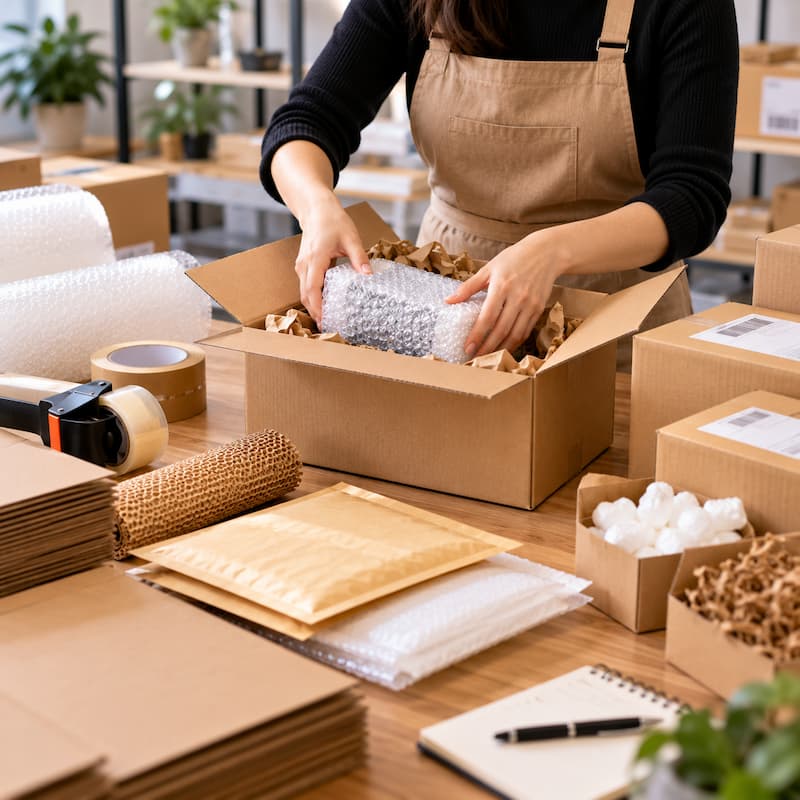
Beyond the outer box or mailer, the materials used inside and around the package play an equally important role. This is where many businesses build out their core e-commerce shipping supplies, the everyday consumables that keep operations running smoothly and shipments arriving intact.
A well-stocked packing station typically includes cushioning materials, sealing tape, labels, and fillers suited to the specific products being shipped. Having the right combination on hand reduces packing time, minimizes waste, and ensures consistency across every order that goes out the door.
Void Fillers and Cushioning: Bubble Wrap, Packing Paper, and Air Pillows
Empty space inside a box is one of the leading causes of shipping damage. When a product can shift or move during transit, it is far more likely to arrive scratched, dented, or broken. Void fillers solve this problem by keeping items snug and immobile throughout the journey.
Bubble wrap remains a popular choice for fragile or oddly shaped items, offering flexible cushioning that molds around corners and edges. Packing paper is a lighter, more sustainable option for filling gaps around sturdier products, while air pillows provide an efficient and lightweight way to fill larger voids without adding much weight to the package. Choosing the right combination of these materials depends on the product's fragility, shape, and the overall box size being used.
High-Adhesion Packaging Tapes for Secure Sealing
A box is only as secure as its seal. Using low-quality or thin tape is one of the most common mistakes businesses make, often leading to packages that pop open during handling or transit. High-adhesion packaging tape, ideally applied in an H-pattern across the top and bottom seams, provides the strength needed to keep a box closed under pressure.
Reinforced tapes, including those with fiberglass strands, are worth the investment for heavier shipments or businesses sending products through multiple handling points. A properly sealed box not only protects the contents but also signals professionalism to the customer receiving it.
Branding Your Packages: Custom Labels and Tape
Packaging is one of the few physical touchpoints a business has with its customers in the entire online shopping journey. While the website and checkout experience are digital, the box that arrives at someone's door is tangible, memorable, and shareable. This makes packaging a genuine branding opportunity, not just a functional necessity.
Businesses that invest in custom labels, printed tape, or branded inserts often see a noticeable difference in how customers perceive their professionalism. A generic brown box says little, but a package with a recognizable logo, consistent color scheme, or a thoughtful printed message tells the customer that real care went into their order.
How Custom Labels Transform a Standard Box into a Marketing Asset
Custom labels do more than just look attractive. They reinforce brand recognition every time a customer sees the package, whether it is sitting on their porch or being unboxed on social media. Many businesses now design labels that double as promotional tools, including QR codes linking to loyalty programs, social media handles, or discount codes for future purchases.
A standard box wrapped in branded tape and topped with a well-designed label can feel like a small unboxing event rather than a routine delivery. This kind of attention to detail costs relatively little compared to the marketing value it generates, particularly for businesses trying to build a loyal, repeat customer base.
Eco-Friendly Packaging Trends for Modern Businesses
Sustainability has moved from a nice-to-have to an expectation for many online shoppers. Customers increasingly notice when a business uses excessive plastic or oversized boxes, and many actively seek out brands that align with their environmental values. This shift is pushing businesses of all sizes to rethink their packaging strategies.
Eco-conscious packaging does not have to mean sacrificing protection or professionalism. In fact, many sustainable materials now perform just as well, if not better, than their conventional counterparts, while also reducing a business's overall environmental footprint and material costs over time.
Sustainable Mailers and Recyclable Boxes Your Customers Will Love
Recyclable corrugated boxes, biodegradable mailers, and paper-based void fillers are becoming standard choices for businesses looking to reduce waste without compromising on quality. Many of these materials are made from recycled content and are fully recyclable themselves, allowing customers to dispose of them responsibly after unboxing.
Switching to sustainable options can also become part of a brand's story, something worth highlighting on product pages or included as a small note inside the package. Customers who feel good about how a product arrived are more likely to feel good about the brand as a whole, strengthening loyalty over time.
Streamline Your Deliveries with Topping Courier
Great packaging solves half the equation, but reliable delivery completes it. Even the most carefully packed order needs a shipping partner that can get it to the customer's door quickly, safely, and on schedule. This is where a dependable local courier makes all the difference for businesses trying to keep up with customer expectations.
Topping Courier works with businesses across the region to provide business shipping and packaging solutions that fit real-world operations, not just theoretical best practices. From helping businesses choose appropriate materials to handling the final delivery leg, the goal is always the same: fewer damaged shipments, happier customers, and smoother day-to-day logistics.
Fast, Reliable Business Delivery and Packaging Solutions
For businesses operating in the Greater Toronto Area, speed matters just as much as protection. Same day delivery Toronto services allow businesses to meet tight customer expectations without sacrificing the care that goes into how each order is packed and sealed. Whether it is a single fragile item or a full batch of daily orders, having a courier partner that understands both packaging and delivery timelines helps businesses stay competitive in a market where customers expect both speed and reliability.
Combining smart packaging choices with a trusted delivery service is ultimately what separates businesses that scale smoothly from those that struggle with returns, complaints, and lost customers. Investing in both is not an added expense. It is a foundation for sustainable growth.
Get 30% Off Your First Month
If you are looking for value for your money and want to ensure you get the best courier services Toronto has to offer, contact Topping Courier today and receive 30% off your first month! We specialize in quick same day courier Toronto services and provide our clients with competitive prices they cannot find elsewhere.
Frequently Asked Questions About E-Commerce Packaging
Packaging decisions often come with practical questions, especially for businesses scaling their shipping operations for the first time or looking to optimize existing processes.
How do I choose the right box size to reduce shipping costs?
The best approach is to measure your most frequently shipped products and select box sizes that leave minimal empty space once cushioning is added. Oversized boxes increase dimensional weight charges and require more filler material, while undersized boxes risk damaging the product. Many businesses keep two or three standard box sizes on hand to cover the majority of their catalog efficiently.
What is the best material for fragile product shipping?
Fragile items generally do best in sturdy corrugated boxes combined with generous cushioning, such as bubble wrap or air pillows, to prevent movement during transit. Double-wall boxes offer added protection for particularly delicate or valuable items. Sealing with high-adhesion tape in an H-pattern further reduces the risk of the box opening under pressure.