
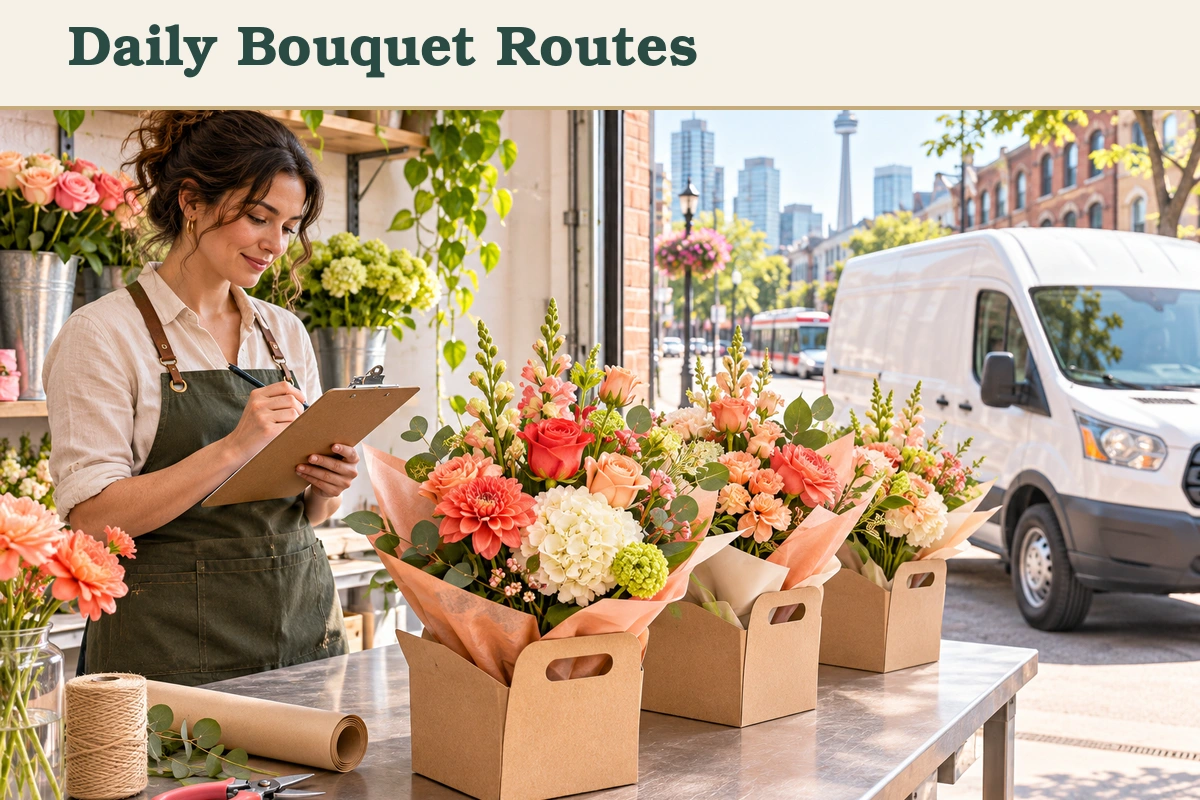
Plan daily bouquet pickups around ready times, venue deadlines and upright capacity. Build a manifest and track exceptions after each run.
Build florist delivery routes GTA shops can repeat by setting one bench-ready time, confirming receiving windows, and grouping flexible deliveries around the fixed ones. Release the driver only when the manifest, packaging and handoff instructions agree. Keep late orders outside the run until dispatch checks them against the confirmed stops. Discuss a pilot pickup through Scheduled Courier Delivery Toronto & GTA before publishing a recurring promise.| Decision | Working rule |
|---|---|
| Pickup timing | Set the shop's ready deadline before the booked handoff. |
| Stop order | Place verified venue or customer deadlines first, then group flexible stops. |
| Vehicle capacity | Count usable upright positions and access to each package. |
| Manifest | Record order ID, contact, window, entry and authorised fallback. |
| Late additions | Accept only after checking capacity and all confirmed windows. |
| Route close | Reconcile every picked-up order against proof, exception or return. |
Set Up Florist Delivery Routes GTA Shops Can Repeat
Work backward from the most restrictive receiving point and give your team a realistic bench deadline. Use the same structure each day, then adjust the schedule to the actual orders.
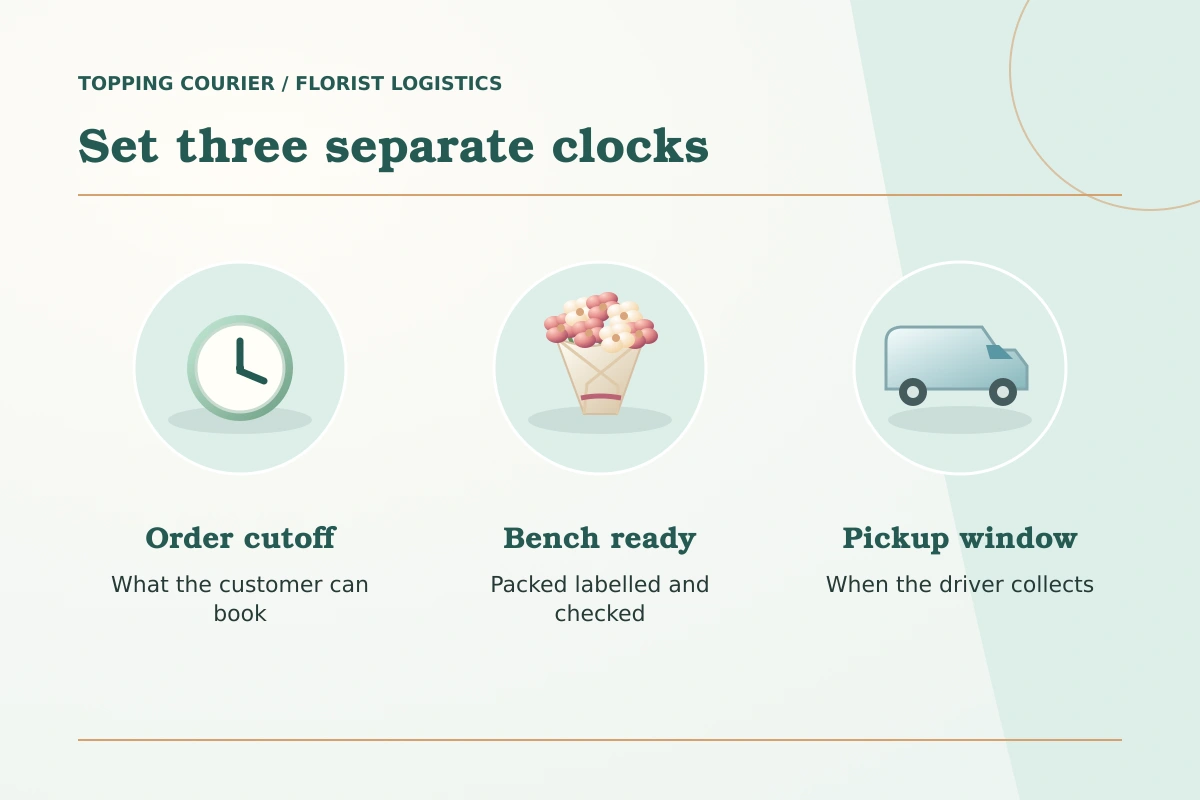
Set three separate clocks
Write down the customer order cutoff, the time the bouquet must be ready and the booked pickup window. The order cutoff controls what the shop promises. The ready time includes arranging, checking the card, packing the bouquet and resolving missing instructions. The pickup window belongs to dispatch. A confirmed order is still unfinished until the package is labelled and staged. A florist wrapping a bouquet as the driver arrives has used the margin intended for unpredictable traffic and receiving delays.
Build the first schedule from observed handoff times. Write down when arrangements become ready, when a driver accepts the count and when the first stop actually starts. Run the same type of collection again before moving an internal deadline. A nursery pickup, condo tower and funeral home are different jobs even if their postal codes are close. Treat specific-time requests as constraints only after the service and receiving point confirm them.
Start with deadlines and upright capacity
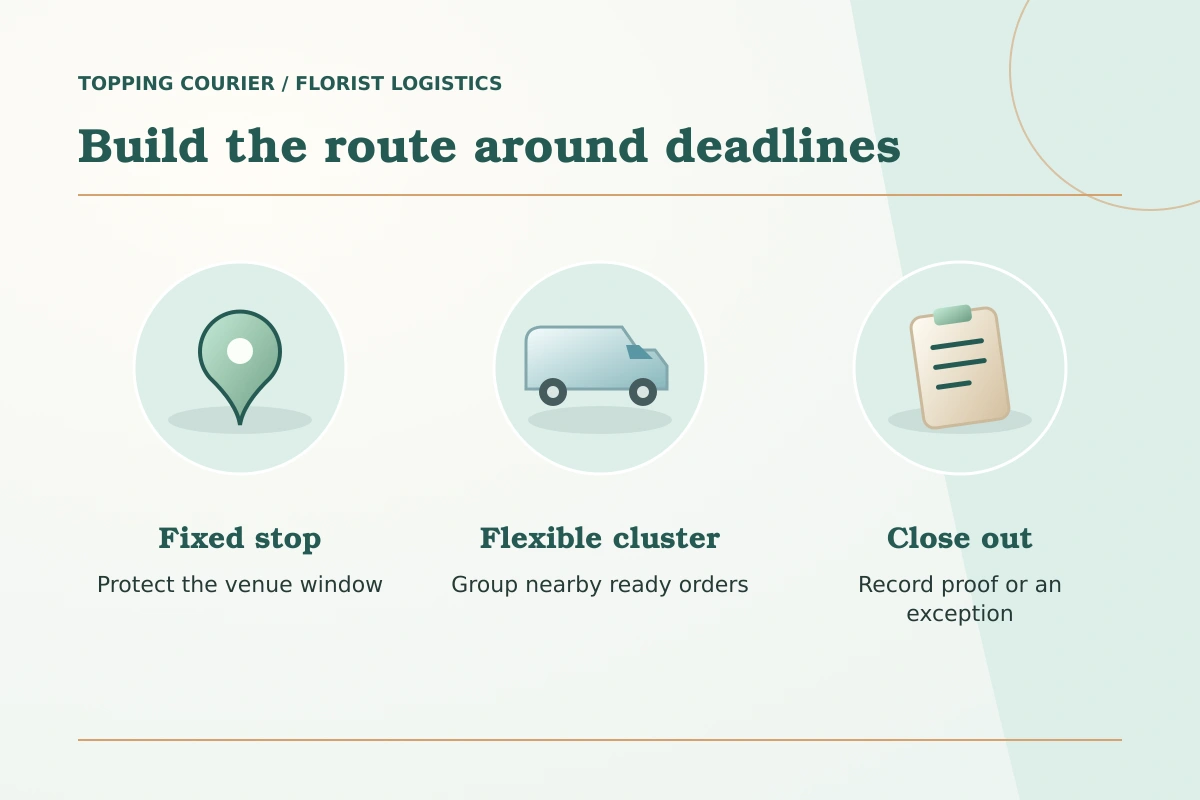
Map the stops by actual address and group nearby flexible orders. Mark hard closing times or event receiving windows first. Confirm whether a time is the recipient's preference or an agreed deadline. Preserve room for stops that involve a loading entrance, security desk or walk from lawful parking. The City of Toronto's traffic and parking code sets conditions for commercial loading zones. Check posted signs and confirm the receiving location instead of planning around a curb that may be unavailable.
Count floor positions for tall boxes and vases, then check whether early stops can be reached safely after loading. A car with adequate overall space can still have an opening too short for one arrangement. Measure the carrier at its widest and tallest points, including blooms and handles. Put fragile, upright-only or heavy pieces on the manifest and confirm vehicle and packaging requirements with the courier.
Set the route boundaries before the first collection. Keep a standing list of streets, buildings and venue types that need extra handling, and review it at the planning meeting. Separate a normal area from an additional area that dispatch can accept only after reviewing the order. When a fringe stop sits beyond the rest of the batch, estimate its effect on the whole route, including the drive back to the next cluster. Check the order can still be reached without moving or tipping a different package. If doing that breaks the plan, reserve a different run for the stop.
Routific’s published Bear’s Blooms case study describes an actual flower subscription business using daily dispatch planning and customer notifications across several cities, including Toronto. The useful lesson for a storefront is to give dispatch a single list of addresses and make delivery updates part of the workflow. Before adopting the same approach for a bouquet shop, also record the dimensions and handoff rules that determine whether those stops can travel together.
Read more: Same Day Courier in Richmond Hill: Fast, Local Delivery for Growing Businesses
Build a Manifest Your Driver Can Use
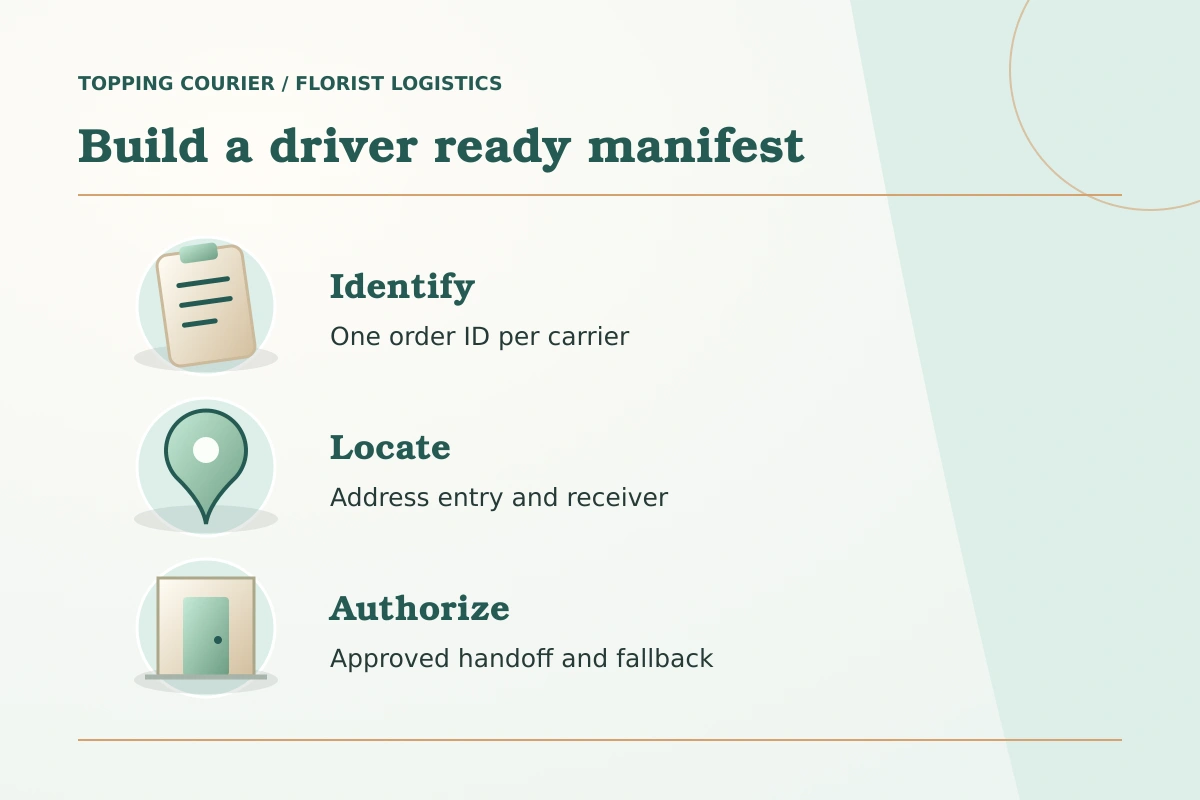
Give each package one durable order ID and one useful handoff instruction. Keep contact details in the agreed manifest where dispatch can update them without confusing the package label.
- List the pickup contact and entrance. Identify the door, the shop phone and where the driver checks the count. State whether the pickup is a single handoff or several collection points. Give staff a matching manifest so both sides acknowledge the same quantity.
- Capture the receiving details before the bouquet leaves. Include street address, unit, relevant buzzer or desk, receiver phone and operating window. A venue order should carry the building, the entrance, the receiving contact and the event or department reference needed to identify it. Verify that the site accepts the arrangement.
- Identify the handling group. Record package dimensions, vase or hand-tied format, upright handling, extra pieces and whether a container must be returned. Mark an arrangement too tall to turn inside an access corridor and make the handoff route part of the briefing.
- Put the fallback beside the stop. Give the driver an approved instruction for no answer or missing access and the dispatch contact who can authorise a change. A concierge handoff, authorised safe place and return to shop are different outcomes. Capture which authority approved the chosen outcome.
- Keep statuses concise. Use ready, collected, delivered, attempted and returned as separate states. Add a short reason such as desk closed or address correction. Close a delivered stop with the agreed evidence and leave any exception open until the shop assigns the next action.
- Publish changes to the active run once. If a recipient confirms a new entrance, dispatch updates the manifest and gets acknowledgement. Avoid instructions spread across chats, texts and paper notes, especially under holiday pressure.
Read more: Packaging for local deliveries: a simple checklist
Run a Daily Bouquet Pickup From Bench to Door
Start the example run with one verified venue deadline and two flexible groups. A hypothetical shop in North York has a sympathy arrangement, two home deliveries in the same area and a condo delivery closer to the downtown core. The funeral home confirms a receiving window and gives the shop a direct phone number. The homes accept a broader window, and the condo has an authorised desk handoff. The shop separates the fixed-time arrangement on the bench, checks the entry with the venue and assigns a driver-accessible position to that first stop. The dispatcher confirms usable capacity and saves a destination contact for each group. Before release, staff check that the signature or photo process fits any site restrictions.
Load the route so the first arrangement leaves without moving the others. The operator chooses an order that protects the venue deadline, then batches the two nearby homes. The condo stays in a flexible position, provided reception is open at the planned arrival. When a late checkout request comes in, the florist checks the new recipient's hours and package format. Dispatch sees that inserting it would use the time needed to get the venue order through reception and declines to alter this run. A separate Same-Day Courier Toronto & GTA booking is a possible alternative after confirming availability, handling and the destination window. If the sender cannot accept that option, offer the next confirmed pickup rather than telling the first driver to improvise.
Close the run by matching each order ID to its receiving outcome. In this example the venue and homes are delivered, but the condo has replaced its staffed desk with a locked entry. The driver reports attempted access and the dispatcher contacts the authorised receiver using the agreed channel. The package stays with the courier while the shop checks the fallback. There is no approved placement out front, so dispatch applies the shop's return instruction. Staff record it as an access exception, check the bouquet on return and contact the sender to agree on the next action. That distinction keeps a route delay report from attributing a building access problem to driving time and gives the shop the exact detail it needs for the next order to that address.
Read more: Same Day vs Next Day Courier in Toronto: Which One Fits Your Business?
Review the Route Before You Add Stops
Review every exception after the pilot and name what caused it. Measure the stages separately so you know whether to change the shop cutoffs, the stop order or the receiving instructions.
-
Bench readiness: compare the planned time with the time the entire order was packed and labelled. If the final pending order repeatedly delays pickup, adjust its cutoff, move it to a separate wave or reserve its packaging before the rush starts.
-
Pickup-to-first arrival: track driving and the handoff at collection separately. Check whether the driver waited for a count, found the wrong door or had difficulty reaching the vehicle with a tall arrangement.
-
Stop service: record arrival and completion where available. A busy concierge and a loading entrance with limited hours can add time after the vehicle reaches the area. Use those records to set the next schedule.
-
First attempt: count stops completed on first attendance and classify failures. Adding more stops while the same information gap remains will increase the number of exception calls.
-
Condition and returns: compare departures with returns. If containers shift or wrapping is wet, look at restraint and loading before weakening time commitments. Recheck the package and vehicle fit with the actual arrangement mix.
-
Handoff evidence: confirm someone at the shop can find the record using the order ID. Topping's Toronto courier services describe tracking and photo proof. Confirm how each kind of stop is recorded and avoid promising a specific evidence type where a venue prohibits it.
-
Track ready orders that were moved to a separate wave before pickup. That count shows whether the first route is meeting the shop's demand. Check whether an order was moved because it arrived late, lacked receiving details or exceeded the vehicle's handling capacity. Give the person who operates checkout enough information to respond to the recurring reason.
Read more: Proof of delivery: what you get with every Topping delivery
Frequently Asked Questions
Build rules around actual stops and package sizes. Use these answers when starting a new daily run.
How many bouquets fit in one pickup?
Count the upright positions and access to each one after loading. Give the courier dimensions and the mix of containers, including tall pieces that need more doorway clearance. Plan fewer stops when collection or handling adds constraints.
Should all stops in one postal code go together?
Group nearby flexible stops, then check whether travel, doors and agreed receiving times allow that sequence. Two nearby addresses can need different slots when one desk closes early or there is no authorised recipient.
Should I promise a fixed delivery time?
Give a fixed time only when the service and recipient arrangements support it. Use a published window for routine runs, and flag fixed event or facility acceptance before building the manifest.
What do I do with an order that arrives after dispatch?
Keep it out of the active run while dispatch checks all existing commitments. Confirm package size, access and receiving time. Offer a separate collection or the next route where insertion would put the run at risk.
What if a holiday brings more orders than the driver can carry?
Stage a separate wave, protect fixed deadlines and brief the team on which orders move. Revise available booking windows at checkout as soon as capacity changes. Measure capacity with loaded carriers and stop times, not a count of receipts.
Read more: Courier Service Toronto: 6 Red Flags That Mean It's Time to Switch Providers
Set Up Your Next Pickup With Topping Courier
Review Scheduled Courier Delivery Toronto & GTA and start with a pilot run that reflects your real bouquet mix.
Share your shop ready time, stop areas, window constraints, vehicle needs and exception instructions. Ask how the courier will receive updates and close failed handoffs.
Contact Topping Courier to confirm service and shipment suitability before offering a recurring delivery window.