
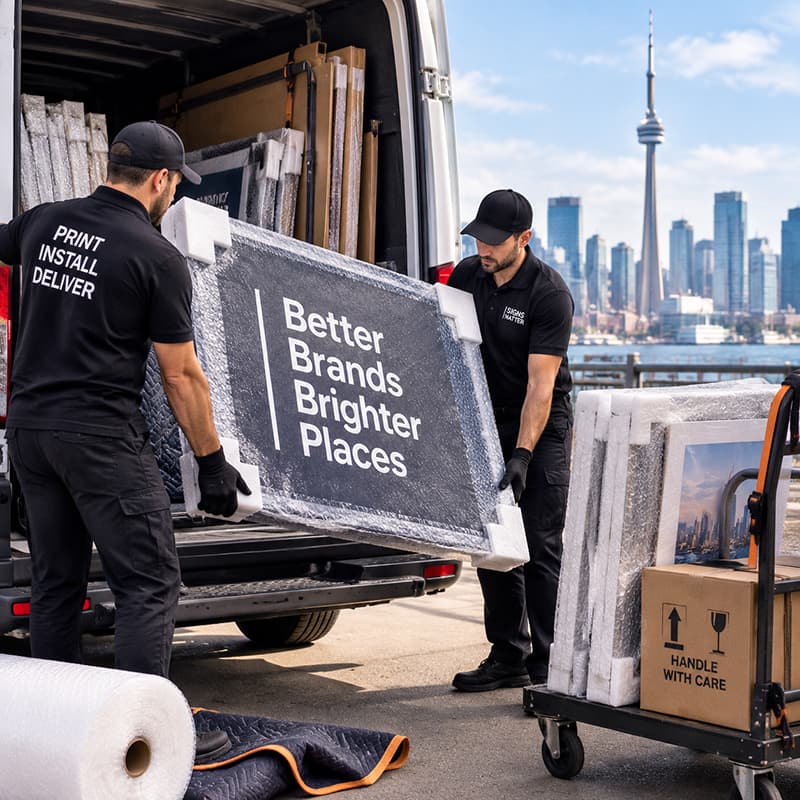
Stop damaging your valuable custom signs. Learn expert tips for safely transporting print products across Toronto and preventing costly transit damage.
A flawless sign can leave a print shop looking perfect and arrive at the installation site with a crushed corner, a scratched face, or water damage. Large-format print products are especially vulnerable because their size, shape, and surface finish do not fit ordinary parcel-handling systems. If you need to transport print products Toronto businesses depend on, careful packaging is only half the solution. The vehicle, loading method, handling process, and delivery timing all matter.
This guide explains why signs and commercial print materials are damaged in transit, how to prevent the most common failures, and when a specialized courier is the safer choice for deliveries across Toronto and the Greater Toronto Area.
The Hidden Costs of Damaged Print Deliveries in the GTA
A damaged sign costs more than the value of the material. It can trigger reprinting, extra labour, a second delivery, delayed installation, and an uncomfortable conversation with the client. When a campaign, store opening, trade show, or construction handover has a fixed deadline, even minor damage can become a major business problem.
Related Reading Express Courier Toronto vs. Standard Shipping: Which Option Fits Your Needs? →
Why Standard Couriers Fail When Shipping Oversized Signage
Standard parcel networks are designed to move boxes of predictable dimensions through sorting facilities, conveyor systems, loading bays, and densely packed vehicles. Oversized signage does not move safely through that environment. Foam boards can bend, acrylic panels can crack, and mounted prints can be scraped when they slide against other freight.
The problem is not necessarily careless service. It is often a mismatch between the shipment and the delivery system. A parcel courier may measure success by how efficiently a vehicle is filled, while a delicate sign may require open floor or wall space, upright positioning, and minimal handling. Long or irregular pieces can also become leverage points during loading, putting pressure on corners and edges.
A dedicated signage delivery courier GTA businesses can book for commercial print work reduces these conflicts by matching the shipment with a suitable vehicle and a more controlled delivery process.
The Financial and Reputational Impact on Local Print Shops
When a finished product arrives damaged, the print shop often carries the visible blame—even if the damage occurred after pickup. Reprinting consumes substrate, ink, finishing materials, machine time, and staff capacity. If installers have already arrived, their waiting time or repeat visit may create another charge.
The reputational cost can be harder to calculate. A client who receives a damaged lobby sign or event graphic may question the print shop’s quality control. Repeated delivery problems can weaken referrals and reduce the chance of winning recurring work from retailers, agencies, property managers, and event organizers.
For that reason, delivery should be treated as the final production stage, not as an unrelated transaction. The right print shop courier service Toronto providers offer should support the same quality standard that applies inside the shop.
The Immediate Stress of Last-Minute Reprinting and Deadlines
Print deadlines are often connected to events that cannot be moved. A banner may be needed before doors open, window graphics before a product launch, or presentation boards before an important meeting. If damage is discovered at delivery, the available response time may be measured in hours.
Emergency reprinting disrupts the entire production schedule. Staff may need to pause other jobs, locate replacement stock, repeat finishing work, and arrange another vehicle. A same day courier service GTA print businesses can rely on may help with urgent recovery, but prevention is still less expensive and less stressful than a last-minute rescue.
Common Mistakes That Lead to Ruined Print Media
Most transit damage is predictable. It usually results from weak protection, exposure to weather, or movement inside the vehicle. Understanding these failure points makes it easier to create a repeatable dispatch checklist for every sign, banner, poster, or display panel.
Inadequate Corner Protection and Edge Crushing Corners and edges are the first points to make contact with floors, door frames, walls, and other items. A sheet may look well wrapped while its most vulnerable areas remain exposed. Bubble wrap alone can compress under pressure and may not prevent a rigid board from denting.
Use rigid corner guards that match the thickness of the product. Protect long edges with foam profiles, corrugated channels, or another non-abrasive material. Where possible, add a rigid outer layer so an impact is spread across a larger area rather than concentrated at one point. Never apply tape directly to a printed or finished surface. Weather Vulnerability: Rain, Moisture, and Paper Degradation Toronto weather can change quickly, and damage can occur during the short distance between a shop door and a vehicle. Rain, snow, slush, and condensation may stain paper products, weaken cardboard packaging, affect adhesives, or cause curling and warping.
Wrap paper-based and moisture-sensitive items in a sealed protective barrier before they leave the building. Do not assume a cardboard sleeve is waterproof. Keep wrapped products off wet pavement, and confirm that the receiving location is open and ready before unloading. During winter, allow temperature-sensitive materials to acclimatize when recommended by the manufacturer instead of installing them immediately after exposure to cold conditions. Improper Stacking and Weight Distribution in Transit Flat does not always mean safe. A large board placed beneath boxes or equipment can crack or permanently bow. A stack of panels can also shift during braking, allowing surfaces to rub together. Rolled media may be crushed when heavy items are placed on top of the tube.
Separate print products from unrelated cargo whenever possible. Place lightweight protective sheets between finished faces, distribute support evenly, and never use delicate boards as a platform for other goods. If products must travel upright, secure them so they cannot fall or flex. The correct orientation depends on the substrate, dimensions, frame, and manufacturer guidance.
Related Reading Business Courier Toronto: B2B Shipping Solutions for E-commerce Stores →
Essential Rules for Safe Signage and Print Transport
Safe delivery starts before the courier arrives. Print shops should document their packaging standards, inspect each item before dispatch, and communicate unusual dimensions or handling requirements when booking. A few extra minutes of preparation can prevent hours of rework.
Proper Packaging and Padding for Delicate Substrates
Packaging should be selected for the actual material rather than applied as a universal solution. Acrylic needs scratch protection and shock absorption. Foam board needs bending and corner protection. Framed pieces may need glazing protection, while paper prints need clean, dry, crush-resistant packaging.
A practical packaging sequence is:
- Allow inks, coatings, laminates, and adhesives to cure fully.
- Cover the printed face with a clean, non-abrasive protective layer.
- Add rigid corner and edge protection.
- Cushion the item without placing pressure on raised lettering or hardware.
- Use a rigid outer carton, crate, sleeve, or protective board when appropriate.
- Seal the package against dirt and moisture.
- Photograph the packaged item and its condition before pickup.
For high-value or unusual materials, follow the substrate or fabricator’s handling instructions. If there is any uncertainty, test the protective material on an offcut before placing it against the finished print.
Securing Large Banners and Rigid Boards in Transit
Large banners should normally be rolled around a suitable core with the printed side oriented according to the printer’s finishing guidance. Avoid tight folds unless the material is designed for folding. Place the roll in a strong tube with protected ends, and prevent it from rolling freely inside the vehicle.
Rigid boards require restraint without excessive pressure. Use padded straps, non-slip supports, partitions, or a rack designed for flat materials. Straps should hold the load in position but should not create indentations. Long items must be supported along enough of their length to prevent sagging.
Before dispatch, provide the courier with the exact length, width, thickness, weight, quantity, and preferred orientation. These details help determine whether a car, cargo van, or larger vehicle is appropriate.
Labeling Fragile and High-Value Commercial Shipments
Labels do not replace protective packaging, but they make handling requirements visible. Clearly identify the package as fragile and add direct instructions such as “Do Not Stack,” “Keep Dry,” “This Side Up,” or “Carry Upright” when applicable. Mark the opening side so the recipient does not cut into the product.
The delivery record should include the client name, complete address, unit or loading-bay information, site contact, phone number, delivery window, and any access restrictions. For multi-piece jobs, number every package and state the total, such as “2 of 5.” Include the job reference without displaying unnecessary confidential information.
Why Specialized Print Logistics Changes Everything
Specialized delivery creates a controlled link between production and installation. Instead of forcing an unusual print product into a standard parcel workflow, the shipment can be planned around its dimensions, fragility, deadline, route, and unloading requirements.
The Advantage of Custom-Equipped Vehicles for Fragile Cargo
The safest vehicle is not always the largest one. It is the vehicle that provides sufficient space, clean loading conditions, suitable anchor points, and the correct orientation for the item. A van may accommodate long banners and boards without folding them, while partitions, racks, blankets, and straps can reduce movement and surface contact.
Matching the vehicle to the shipment also prevents oversized pieces from being forced through small doors or placed diagonally under tension. When booking a courier GTA delivery, provide accurate measurements rather than relying on descriptions such as “large sign.” The courier can only plan properly when the shipment details are clear.
Trained Handlers Who Understand Commercial Print Products
Commercial print products require deliberate handling. A trained handler knows not to lift a large panel by one corner, drag a wrapped sign across the floor, rest a printed face against a rough surface, or tighten a strap over an unsupported area.
Good handling also depends on communication. The driver should know which side faces up, whether the item must remain flat or upright, where it can be safely held, and whether assistance is required at pickup or delivery. The print shop should disclose sharp hardware, fragile mounts, wet inks, or temperature-sensitive components before collection.
Eliminating Transit Risks Across Toronto and Surrounding Areas
No delivery method can eliminate every possible risk, but direct routing, fewer handoffs, suitable vehicle selection, and real-time communication can reduce exposure. These controls are especially valuable when navigating Toronto congestion, condominium loading rules, restricted commercial entrances, construction zones, and tight event schedules.
Topping Courier’s published service features include real-time tracking, instant pricing and ETA calculations, route and vehicle selection, communication with drivers and dispatchers, and secure handling. Together, these tools can give print businesses better visibility from pickup to delivery and help teams respond quickly if site access or timing changes.
Protect Your Business Reputation with Professional Delivery Solutions
Your client judges the finished sign at the moment it arrives—not when it leaves the printer. Protecting that final impression requires packaging that suits the substrate, a vehicle that suits the dimensions, clear handling instructions, and a delivery process with minimal unnecessary movement.
Before booking, measure every piece, confirm the deadline and receiving contact, document its condition, and explain any special loading or unloading needs. Topping Courier supports deliveries across the GTA with real-time tracking, vehicle selection, ETA information, and direct communication features. For delicate, oversized, or urgent commercial print shipments, contact the team in advance to confirm the appropriate service and handling requirements for your specific job.
Get 30% Off Your First Month
If you are looking for value for your money and want to ensure you get the best courier services Toronto has to offer, contact Topping Courier today and receive 30% off your first month! We specialize in quick same day courier Toronto services and provide our clients with competitive prices they cannot find elsewhere.
FAQ
How should a large printed sign be packaged for delivery?
Protect the printed face with a clean, non-abrasive layer, reinforce all corners and edges, add padding, and use a rigid outer cover when the substrate requires it. Keep adhesive tape away from the finished surface. The package should also be sealed against moisture and labeled with its correct orientation and stacking restrictions.
Can rigid signs and rolled banners travel in the same vehicle?
Yes, if each item is packaged separately and secured so it cannot shift, collide, or carry the weight of another product. Rolled banners should be placed in strong tubes, while rigid signs should be supported and restrained without pressure points. The courier should know all dimensions and quantities before assigning the vehicle.
When should I use a dedicated courier instead of a standard parcel service?
A dedicated courier is worth considering when the print product is oversized, fragile, high-value, deadline-sensitive, difficult to replace, or unsuitable for automated sorting. It is also useful when the delivery requires direct routing, a specific vehicle, precise timing, live updates, or coordination with installers and site contacts.
Is same-day delivery suitable for delicate print products?
Same-day delivery can be suitable if the item is fully cured, correctly packaged, and matched with an appropriate vehicle. Urgency should never replace proper preparation. Share the exact size, weight, material, orientation, value, deadline, and handling instructions when requesting service.
What information should a print shop provide when booking a courier?
Provide the pickup and delivery addresses, onsite contacts, ready time, deadline, number of pieces, exact dimensions, total weight, substrate type, value, required orientation, and any fragile or weather-sensitive features. Mention stairs, loading docks, parking restrictions, elevators, security procedures, or the need for extra handling assistance.
How can I document the condition of a shipment before pickup?
Photograph the front, back, edges, and corners before packaging, then photograph the sealed package and labels. Record the piece count and note any existing marks. At delivery, ask the recipient to inspect the shipment before moving or installing it and to report visible damage immediately.