
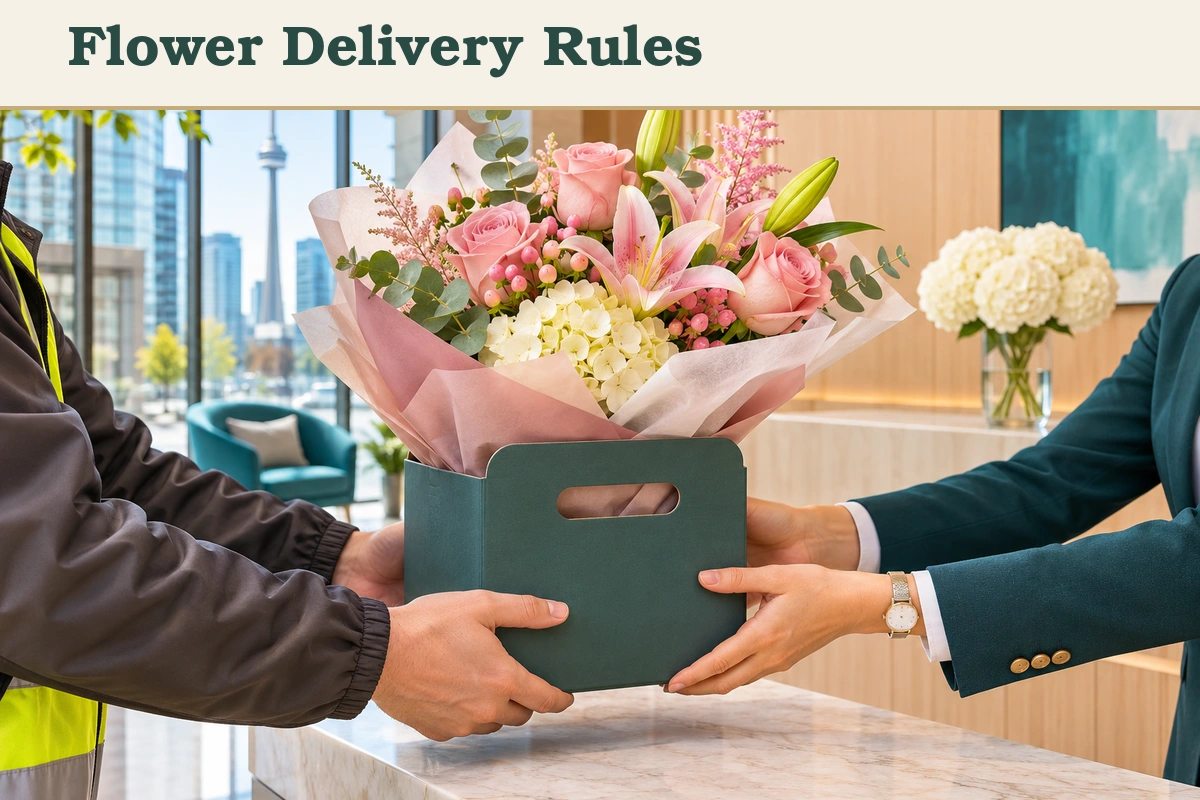
Write clear delivery rules for condos, homes and venues. Set cutoff times, weather limits, proof and what happens if no one can accept.
A florist delivery policy Toronto customers can use states where you deliver, when orders qualify, what counts as handoff and what happens when access fails. Put the key decisions at checkout and give dispatch the same wording. Define weather, receiving restrictions and proof before publishing a promise. Compare the timing your policy needs with Scheduled Courier Delivery Toronto & GTA and confirm the handoff rules before taking orders.
| Policy clause | State this clearly |
|---|---|
| Area and cutoff | Which addresses and orders qualify, and when eligibility closes. |
| Delivery window | The confirmed window, how it is communicated and what is a preference. |
| Receiving instructions | Details needed for houses, condos, offices, hospitals and events. |
| No answer or failed access | Who will be contacted, what release is allowed and when to return. |
| Weather | Which situations rule out unattended placement, and how you notify the sender. |
| Completion | What counts as delivery and how the shop handles proof and issues. |
Florist Delivery Policy Toronto Shops Can Put Into Practice
Publish rules your team can follow on a busy day. Turn every customer-facing promise into a matching field or instruction on the shop's dispatch record.
Explain the cutoff and delivery window
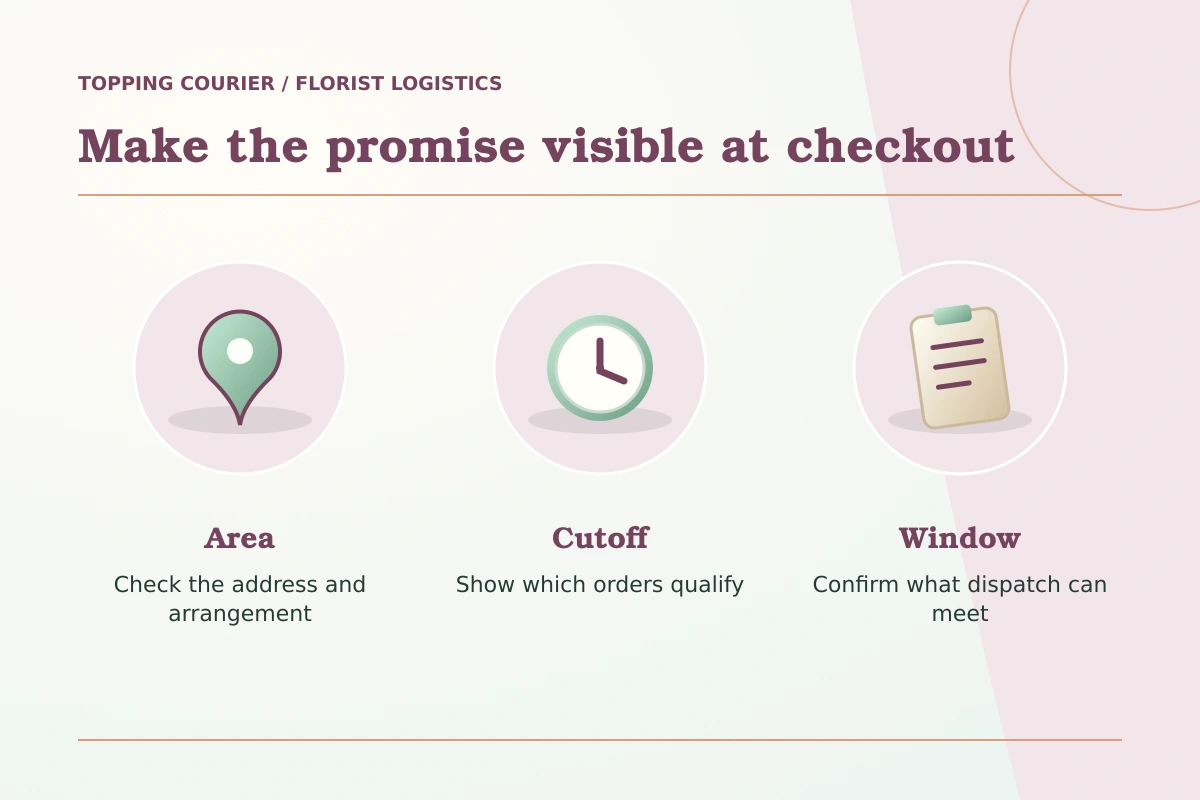
State whether eligibility depends on the postal code, design, date, readiness and available capacity. Show the buyer the available options before checkout completes. An order placed before a shop cutoff still has to be accepted and scheduled against actual capacity. Have one person update the storefront when your next collection is full. Write seasonal exceptions into the same process so a regular promise does not stay live during a changed schedule.
Distinguish order acceptance, pickup and delivery. Use wording such as “We confirm the delivery window after checking the address, arrangement and availability.” For an exact-time request, ask whether the date and hour are essential or preferred. Verify the receiving point and assign a service capable of that window before making a commitment. If a request misses the cutoff, give the next available service window. Review Same-Day Courier Toronto & GTA for the courier's published services and confirm whether the requested shipment and window are suitable.
Write the policy the customer will see
Put the summary beside address entry and timing selection: area, cutoff, delivery window and what happens if nobody can accept. Keep the full policy accessible from checkout and the confirmation. A sender booking a surprise should learn before ordering whether you contact the recipient for building access or to prevent exposure. Save the agreed instructions on the order. If the buyer changes a destination after dispatch, have staff confirm acceptance and revised timing before updating the promise.
List examples of eligibility in the shop’s own language. One order might be a ready-to-go hand-tied bouquet within your regular area. Another might be a tall piece that needs a specific vehicle and a direct venue handoff. Give that second order an explicit confirmation step before accepting its deadline. At checkout, show customers the dates or windows that are actually open and remove the ones dispatch can no longer honour. A product availability message and a service commitment serve different jobs. Staff need to know who checks each one and where to record it for the customer.
Read more: Same Day vs Next Day Courier in Toronto: Which One Fits Your Business?
Write Separate Rules for Homes Condos and Venues
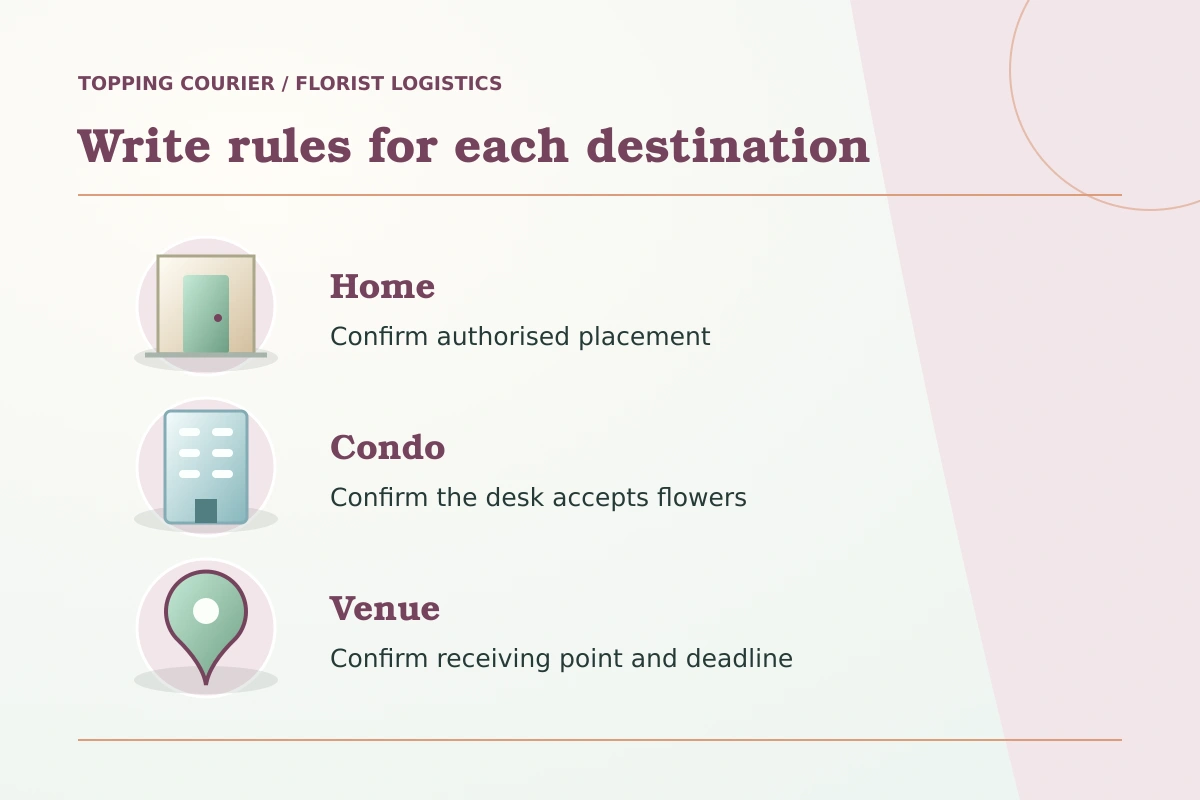
Collect the minimum information that lets the driver find the receiving point and complete the authorised handoff. Set fields by destination rather than asking every customer to answer every question.
- House or townhouse: get the full address and recipient contact. Ask for a gate or entrance detail when needed. Accept an unattended instruction only where the customer has authorised it and the location and conditions suit the arrangement. Define what your staff will do when the location cannot be used.
- Condo or apartment: collect unit, recipient phone, relevant entry detail and whether the desk is allowed to accept flowers. A lobby with an operating desk differs from an unattended common area. Tell buyers what happens if the desk refuses or the driver cannot enter.
- Office: record the business name, suite, receiving desk, hours and person or team authorised to accept. If the building uses a dock, confirm the entrance and receiving window. A driver who reaches the building after reception closes needs a decision from dispatch.
- Hospital or care facility: require the sender to check whether the relevant unit accepts flowers. Verify what information the venue needs and keep sensitive details to a minimum. Ask for the approved receiving point rather than assuming there is access to the room.
-
Funeral home or event venue: confirm when and where staff accept the arrangement, the contact who can resolve a change and the reference needed to identify it. Keep the actual deadline distinct from the advertised service time. Give dispatch a plan for an early arrival or a venue that asks the driver to use a different entrance.
-
Give each special field a purpose. If the recipient's phone is for access, label it that way and explain when staff or the driver will use it. A separate field for a card message keeps private text away from loading notes. Offer a contact channel for time-sensitive orders with information that cannot be gathered cleanly through the website.
- Check that the venue instruction works where the driver can legally stop. Describe whether the contact meets the driver, accepts at a desk or directs them to a receiving point. Confirm operating hours for the actual date, especially for a weekend or holiday. Store the current instruction on the order so the driver sees the version the buyer was given.
Read more: Packaging for local deliveries: a simple checklist
Decide What Happens When a Delivery Fails
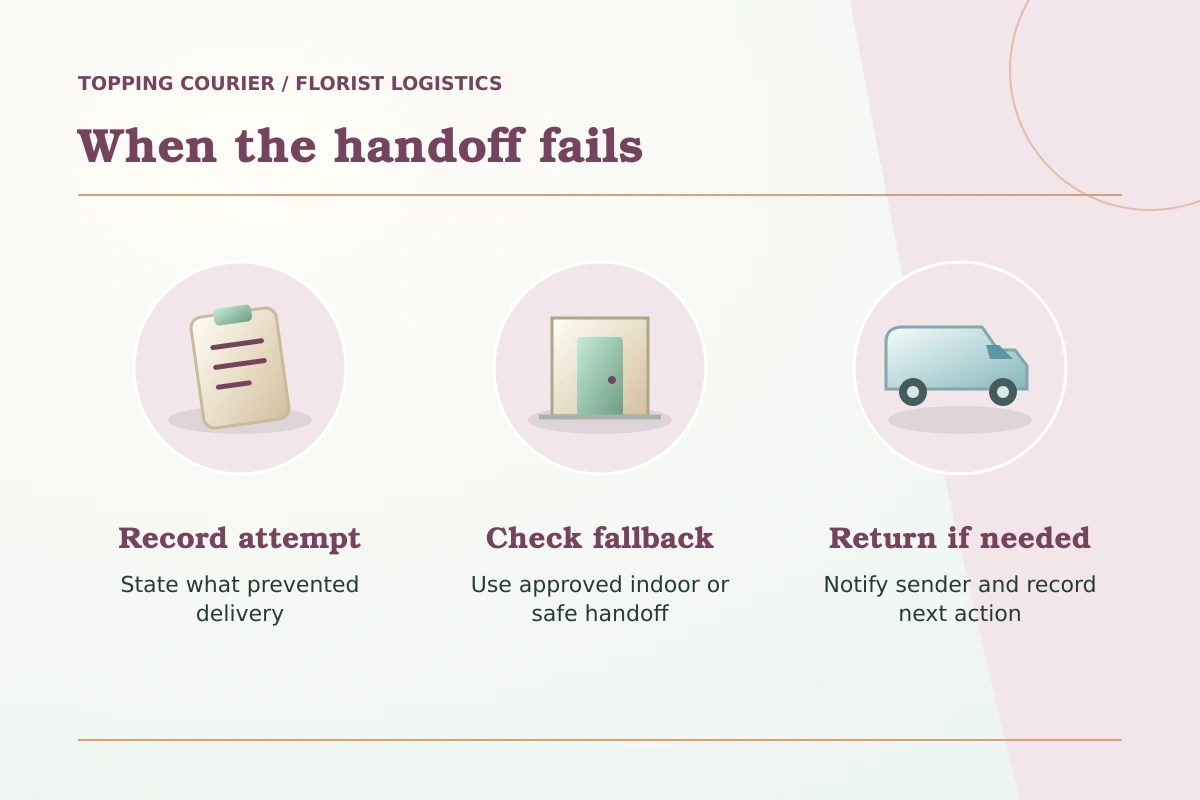
Give dispatch an authorised fallback before the driver leaves the shop. Write the decision in the order record, including who granted permission for any substitute handoff and where the package goes if a handoff cannot happen. A valid fallback must fit the product, the weather, the address, and the instructions the shop and courier agreed to use. A drop site that works for some packages may expose a vase or paper wrap. Keep the return contact and package handling notes in the same workflow so the driver has usable instructions while dispatch tries to reach the sender.
In a hypothetical Toronto condo order, the buyer authorises concierge handoff. On arrival, the desk declines flowers and the recipient does not answer. The driver records an attempted handoff and asks dispatch for the next step. Dispatch checks whether an authorised person can meet the driver and whether there is enough time for that option. A freezing, unsecured lobby entrance does not meet the shop's agreed placement rules. Dispatch instructs a return or another verified action under the policy, records the reason, and alerts the sender. The shop inspects the bouquet on return before arranging any next delivery. If the desk had accepted and the handoff matched the instruction, the shop would close it as delivered to concierge and send the agreed update.
Make responsibilities explicit. Let the driver report access or condition facts. Give dispatch authority to confirm fallback options. Give the shop responsibility for updating the sender and deciding what happens to a returned arrangement. Keep attempted delivery distinct from a return, and keep both separate from delivered. A new address or window becomes active only after the shop and courier confirm it, and all staff use the updated record. This avoids a sender changing a note after departure while the driver follows an older instruction.
The first customer update can be short: “We tried the delivery and the authorised desk could not accept it. We are holding the order while we confirm the next handoff.” Follow that with the next agreed action and its timing when available. Avoid marking the notification as complete until the sender receives the update through the channel used at checkout. Record the outcome so a second staff member can pick up the case.
Read more: Business Courier Toronto: Why Your E-commerce Store Is Losing Customers Over Shipping
Publish Proof and Weather Rules Together
Define delivery by the agreed recipient or approved place. Set the evidence and weather thresholds together so staff can tell when an authorised handoff occurred and when they need to pause the job.
Record the proof you need
Set the milestone that completes the order: direct acceptance, authorised desk acceptance or authorised placement. Document the status and the evidence type team members can retrieve using the order ID. A proof photo records a point in time and should show only what serves the delivery purpose. Keep faces, card messages, access codes and unrelated addresses out of the image where possible. The Office of the Privacy Commissioner of Canada’s guidance on limiting collection explains how to restrict personal information to what is necessary for the purpose. Confirm the details of retention and access in your shop's privacy process.
Agree when weather changes the release decision
Stop unattended handoff when freezing air, heat, precipitation or wind makes the approved placement unsuitable. Give dispatch authority to arrange an indoor handoff or contact the shop. State who monitors the forecast and who turns off the checkout option when conditions change. Tell the sender once the action required is clear and keep the next confirmed step in the same message. For a requested extension or new window, confirm service and receiving availability first. The Toronto courier services page lists service types and tracking features. Agree what your courier can record and which steps still belong to the shop.
Run the draft policy through three short tests before publishing it. Start with a valid handoff, then try a refused concierge delivery and a request arriving outside the order window. Ask customer service and the dispatcher to apply the policy separately and compare the action each would take. If one would mark the order as complete and the other would return it, clarify who authorised the hold or placement. Add that decision to the order form and show where it appears in the confirmation. For any delivery concern, tell customers which channel to use, what order information to bring and who will review the record. Keep the policy and staff instructions aligned whenever the workflow changes.
Read more: Proof of delivery: what you get with every Topping delivery
Frequently Asked Questions
Put the answers where customers choose a date and enter the address. Use the same rules to train the person who accepts orders.
Can I promise an exact time for any flower delivery?
Reserve exact timing for orders where the capacity, service and receiving window have been confirmed. Use a stated window for routine orders. Ask the customer whether the exact time is required and confirm it separately.
What if the buyer wants the flowers to stay a surprise?
Ask how you can reach someone if the address or access detail fails. Explain when the recipient may be contacted. Keep the card message out of operational notes where it serves no delivery purpose.
Are flowers delivered when the concierge accepts them?
Count it as delivery only when the building permits it and the shop's terms and order instruction authorise it. Tell the recipient or sender how to retrieve the arrangement.
How do we handle a wrong address?
Verify the correction with the sender and check it against the current route before changing the stop. Give the driver a single updated instruction. If it cannot be confirmed, follow the failed-access procedure.
When should a florist update the policy?
Review it when you change delivery zones, booking windows, services or handling rules. Also revise it when the same avoidable exception keeps recurring. Update checkout and driver instructions at the same time.
Read more: Courier Service Toronto: 6 Red Flags That Mean It's Time to Switch Providers
Match Your Policy to a Courier Workflow
Review Scheduled Courier Delivery Toronto & GTA with the policy and a sample of destinations you serve.
Share arrangement dimensions, deadlines, weather rules and the fallback for a refused or unavailable handoff. Confirm service and proof before making those commitments to customers.
Contact Topping Courier to plan a pilot booking and test how the policy works from checkout to the receiving door.