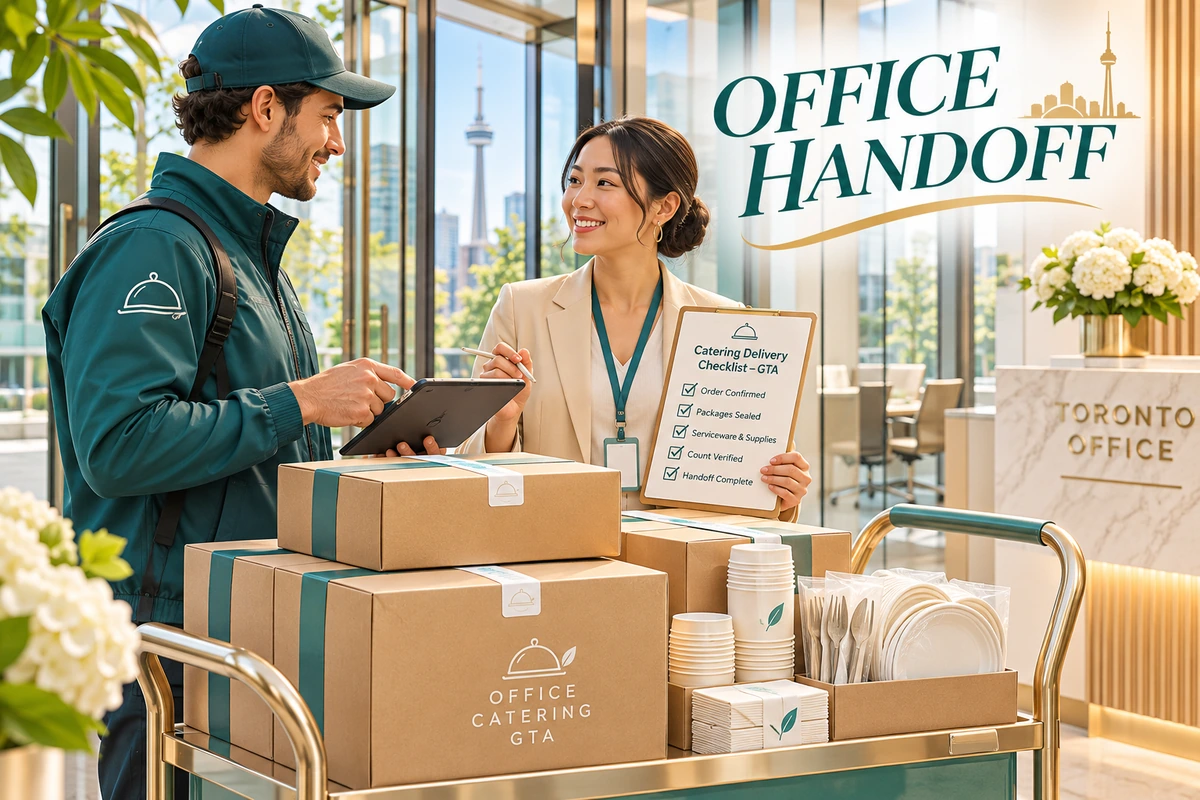
Use this catering delivery checklist GTA before promising an office drop-off: confirm the food’s required holding temperature, choose the proper transport arrangement, count and label every container, map the route from approved loading point to the actual room, and name a receiver who will answer the phone. Topping’s standard booking does not accept perishable refrigerated food without a written agreement. For eligible shelf-stable office supplies and sealed items, explore business courier services.
| Checkpoint | Action |
|---|---|
| Product eligibility | Classify shelf-stable, refrigerated and hot-held items separately before booking. |
| Temperature control | Keep potentially hazardous cold food at 4°C or below and hot food at 60°C or above using a suitable carrier. |
| Count | Record each tray, carton, beverage unit and separate serviceware package. |
| Access | Confirm legal stopping point, entrance, security, elevator, floor and room. |
| Receiver | Name a primary and backup contact with working numbers. |
| Completion | Count at handoff and retain the delivery record against the order ID. |
Classify the menu before booking any delivery
Start with the food, not the route. Bread, sealed shelf-stable snacks and serviceware have different transport requirements from chilled sandwiches or hot prepared meals. Record the storage condition of every menu component before selecting a vehicle. A delivery that is fast but fails to maintain food safety is not an acceptable catering plan.
The Ontario Food Premises Regulation requires potentially hazardous food during transport to have an internal temperature at or below 4°C or at or above 60°C. Toronto Public Health’s event-vendor guidance describes cold-holding, hot-holding and thermometer checks. Do not use the preparation-time exception as a general route allowance, and do not assume an insulated box automatically meets the required internal food temperature.
Topping’s prohibited and restricted items policy excludes perishable food that needs refrigeration unless agreed in writing. For a menu that needs cold control, secure that written arrangement and the equipment to maintain it before dispatch; use a suitable specialist food carrier when it cannot be met. For hot meals, use a carrier and equipment that demonstrably maintain the required temperature. This article’s standard Topping booking examples apply to eligible shelf-stable orders only.
Read more: Packaging for local deliveries: a simple checklist
Write one order sheet that kitchen and receiver both understand
Put the order ID, event name, food-ready time, requested handoff window, full destination address, room, headcount, itemized container count and receiver on one sheet. Add a separate count for utensils, napkins, drinks and equipment. “Lunch for the team” tells the driver nothing about whether a beverage crate or dietary-labelled bag is missing.
Separate three times: kitchen release, courier arrival and meal service. Work backward from the actual time the food must be on the serving surface. Include the building’s security process, elevator movement and room setup in the plan. The catering company, not the courier, decides who assembles food, serves guests and retrieves reusable equipment. Write those responsibilities into the order brief.
Assign a kitchen owner and a destination owner. The kitchen owner signs off the item count and holding method. The destination owner confirms entry, receives the order and checks the count before service. A receptionist who opens the front door is not automatically the person authorized to inspect food or sign for service equipment.
| Order field | Why it matters |
|---|---|
| Container count by category | Catches missing trays, beverages and supplies before departure |
| Dietary meal labels | Protects the intended recipient and prevents mix-ups |
| Service time versus arrival time | Leaves room for access and setup |
| Primary and backup receiver | Avoids an unattended delivery |
| Reusable equipment list | Makes a return pickup a planned task |
Read more: Proof of delivery: what you get with every Topping delivery

Map the route from curb to conference room
Write the approved vehicle stopping point, not merely the street address. Then write the correct tower, loading entrance, security desk, elevator, floor and room. An office campus can have one postal address and several receiving routes. Give the driver directions that begin where the vehicle can legally stop and end at the agreed handoff point.
Confirm whether the service elevator needs a booking or a building escort. Measure carts and large containers against the actual doors and elevator if the order is bulky. Keep a direct phone number for a facilities contact who can respond if security changes an entrance. Give the receiver the courier tracking information and tell them where to meet the driver.
Do not quietly turn a curbside delivery into full buffet setup. State the handoff boundary in advance: curb, lobby, mailroom, office reception or room. If food requires more movement or on-site assembly than the chosen service covers, arrange that service with the caterer’s own staff. A courier stop ends at its agreed destination, not at an implied serving table.
Read more: Office Coffee and Snack Delivery: A Smarter Solution for Busy Businesses
Pack and count without mixing dietary orders
Keep hot and cold potentially hazardous foods in separate, appropriate temperature-control equipment. Seal each tray or carton to prevent leaks and contamination. Label the package with the contents, order ID, destination and applicable dietary identification. Put food-service labels where the receiver can see them without opening every container, while following the caterer’s established allergen controls.
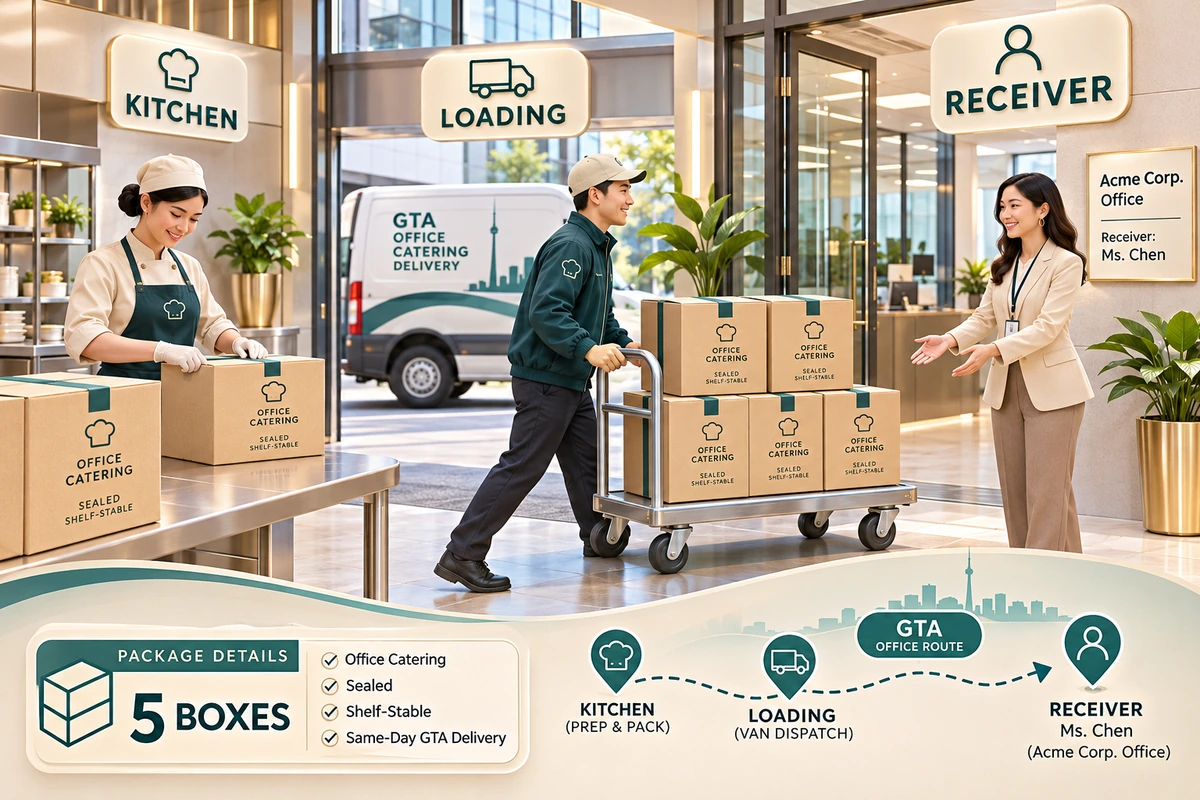
Count physical packages, not menu names. One order may be three food cartons, one drink carrier and one serviceware bag. Record five packages at pickup, then verify five at the receiving point. Mark any dietary meal separately so it is never buried in an unlabelled general carton. If two offices share a pickup, keep their cartons in physically separated groups.
A useful dispatch habit is the “last container” check. Before sealing the vehicle, the kitchen owner reads the order sheet aloud by category while another worker points to each packed unit. The last item is often a separate bag of utensils or condiments rather than the main trays. This two-person visual check is a practical method, not a claim about a particular completed Topping assignment.
Read more: One pickup, many drops: how multi-drop delivery cuts your costs
Choose the service around the food and the building deadline
For eligible shelf-stable supplies, choose scheduled courier delivery when the office needs a defined business-day window. Use same-day courier only within its published booking window and with the goods ready for pickup. Group several eligible shelf-stable drops from one kitchen into a multi-drop booking when their receiving windows are compatible.
Do not batch a chilled lunch with shelf-stable beverage supplies under one ordinary service. Even if both go to the same office, the lunch’s temperature control needs a written arrangement or a specialist carrier. Likewise, a hot buffet requiring 60°C or above needs equipment and a carrier designed to maintain that condition; an ordinary parcel vehicle is not a hot-holding unit.
Take a conflicting scenario: two office snack boxes have flexible afternoon delivery, while a meeting needs hot lunch set out before its guests arrive. Send the eligible shelf-stable boxes on the appropriate planned route. Put the hot meal on a separate food-safe arrangement with a confirmed handoff and setup team. Route consolidation does not outrank safe holding or service readiness.
Read more: Same-day vs next-day courier in Toronto: which one fits your delivery?

Walk the order from kitchen release to office sign-off
This is a model workflow rather than a claimed completed Topping job. An office requests sealed shelf-stable pastries, packaged snacks and serviceware for a staff meeting. The caterer first verifies the products’ storage conditions. Kitchen staff pack the goods in food-safe retail containers, protect those containers with rigid outer cartons and label the dietary-separated items. The kitchen owner counts the cartons, snacks and serviceware against the order sheet.
The booking includes the office tower, legal loading entrance, suite, event room, receiving window and a reachable named contact. The dispatch worker enters the accurate package count. At pickup, the driver checks the physical count against the booking and loads the cartons upright. The receiver follows the tracking update, meets the courier at the agreed point and checks the packages before moving them to the serving area.
After the drop-off, the caterer matches proof of delivery with the order ID and confirms with the destination owner that every counted category arrived. If the meeting room changes, the owner updates the handoff instructions before the courier arrives. If there is no authorized receiver, stop the dispatch until the office names one; do not leave food unattended in a public lobby.
Read more: Last-Minute Holiday Courier Toronto
Plan equipment return as a separate movement
List every reusable tray, carrier, insulated container and cart before the delivery leaves. Assign a location and a person responsible for holding the emptied equipment after the meeting. A delivery receipt proves the outward handoff; it does not schedule the return of property. Make a separate pickup record when the catering provider needs equipment back.
The return point can differ from the meal handoff. Food might arrive at the conference room, while empty crates must go to a loading dock. Confirm the building's collection window and whether security will allow the pickup driver into that area. Label reusable equipment with the catering order ID so it is not mixed with the office's own containers.
At collection, count the returned units against the original equipment list. If the office needs longer before clearing the room, update the collection arrangement before a driver is dispatched. Treat this as a second logistics task with its own receiver and access details, not as an informal extension of the lunch delivery.
Frequently asked questions
Can Topping transport refrigerated sandwiches as a standard parcel?
No. Refrigerated perishable food needs a written agreement and a suitable temperature-control arrangement before booking.
Who checks the dietary meals at delivery?
The named destination owner checks them against the caterer’s labelled order sheet; the courier verifies package count at the agreed handoff.
Can the lobby receptionist accept catering automatically?
No. Confirm the building policy and name an authorized receiver who can check the order.
Is a delivery photo proof that hot food stayed hot?
No. Temperature control requires appropriate equipment and measurement; a photo records the drop-off.
What about collecting reusable trays afterward?
Write a separate collection plan with the equipment count, pickup point and contact before the event starts.
Plan the eligible office delivery
Finalize food eligibility, packing, destination access and receiver details, then book a delivery for eligible shelf-stable items. Use business courier services for recurring routes, and contact Topping before arranging any refrigerated perishables that require a written agreement.