

Batch corporate gift baskets across the GTA with a clean recipient manifest, protected packaging, office handoff instructions and proof for every stop.
Corporate Gift Basket Delivery GTA: How Gift Shops Can Batch Every Drop-OffCorporate gift basket delivery GTA runs smoothly when one dispatch sheet controls every recipient, package, handoff and delivery window. Group baskets by pickup date, verify each office receiver, label each gift with its own order ID, then book the batch as a multi-drop run. For business deliveries across Toronto and the GTA, business courier services give your team one place to organize bookings and tracking.
| Decision | Do this |
|---|---|
| One pickup, several recipients | Create one dispatch batch with a separate delivery record for each address. |
| Recipient in an office | Record building, floor, suite, receiving desk, phone and office hours. |
| Fragile glass or loose products | Immobilize each item inside a rigid outer carton; protect the presentation wrap separately. |
| Perishable refrigerated contents | Do not book a standard run without a written agreement for refrigerated perishables. |
| Delivery deadline | Choose scheduled for a known date and window; choose same-day only within the published cutoff. |
| Completion | Match each delivery’s tracking record and proof of delivery to its recipient row. |
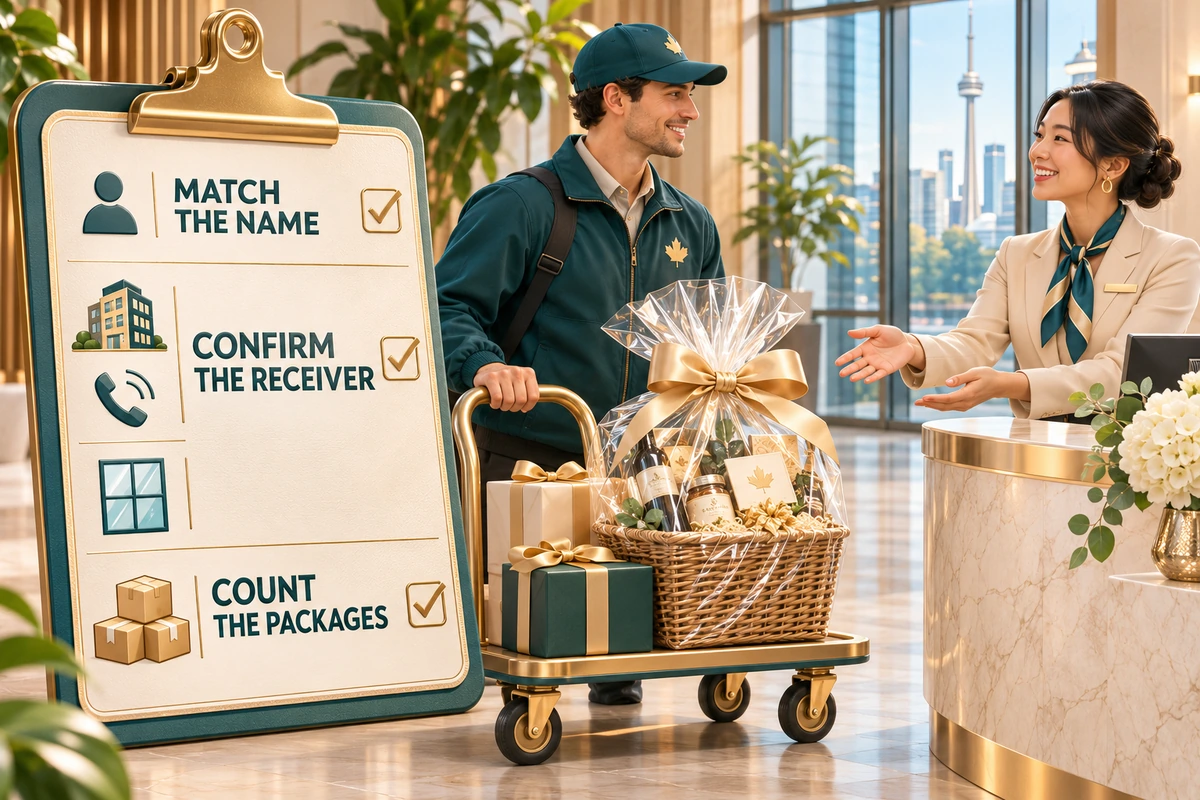
Build a master list before you touch a courier booking
Start with one row per destination. A gift shop making a dozen identical baskets still has a dozen distinct delivery instructions. Put the recipient’s name, company, complete street address, unit, postal code, phone, gift SKU, card message, recipient availability and delivery date in separate columns. Add an internal order ID that follows the basket from assembly to proof of delivery.
Use a second field for the actual receiving person. The executive whose name is on the gift might work remotely; the lobby desk might refuse parcels after its cutoff; an office might require the courier to use a loading entrance. Confirm which person accepts the parcel and where it goes. “Leave with reception” is insufficient when a tower has several desks and a separate mailroom.
Before production, validate duplicate names and repeated addresses. Two employees at the same office are two gifts but could be one drop-off with two labelled packages. Topping’s courier FAQ explains that multiple packages for one address travel under one tracking number with an item count. Keep the two gift IDs distinct in your shop’s own manifest so the receiver can identify both.
Read more: One pickup, many drops: how multi-drop delivery cuts your costs
Pack corporate baskets for handling, not just for display
Use a rigid shipping carton around the finished presentation. Tissue, ribbon and cellophane show the brand; they do not immobilize a jar when a vehicle brakes. Keep heavy jars low, separate glass, fill voids and close the carton so its top cannot press into the bow. Test the packed unit by tilting it gently in your hands. Stop and add support when the contents shift.
Label the outer carton with the recipient, order ID and package count, while keeping the personal message inside the gift. For a basket with a tall handle or a flower-like topper, measure the packed height before selecting the package size. A good dispatch bench has an “assembly complete” area and a separate “driver ready” area; moving a basket across that line means its contents, address and card have been checked. This small physical separation is a practical way to prevent a beautifully finished basket from leaving with the wrong note.
Do not insert alcohol, cash or gift cards into an ordinary booking. Topping’s prohibited and restricted items rules exclude these without the required arrangement and prohibit refrigerated perishables unless agreed in writing. A gourmet basket can contain shelf-stable snacks, but a cheese-and-cream assortment needs a different transport decision. State the contents accurately before dispatch.
| Basket component | Packing decision | Dispatch check |
|---|---|---|
| Glass jar | Wrap individually and cushion within the carton | No contact with another hard item |
| Chocolate or shelf-stable snack | Follow the product’s storage label | No crushing or heat exposure |
| Card and branded insert | Place inside, aligned with order ID | Recipient name and spelling match |
| Chilled item | Hold under the required food controls | Written transport arrangement before booking |
Read more: Packaging for local deliveries: a simple checklist

Choose the delivery service from the recipient’s availability
Choose scheduled delivery for a specific office day and agreed receiving window. Choose next-day for a prepared batch with flexible business-day receipt. Choose same-day when the order and pickup are ready before the published booking cutoff. Topping’s same-day courier and scheduled courier delivery pages show the current service options; check them when booking rather than promising a time from an old sales email.
Prioritize the earliest closing office and the least flexible building access. A route planned by geography alone can send the driver to a tower after its receiving desk closes. For a gift headed to a home address, the receiver’s available window matters more than the office-hours rule. Split the batch if some parcels demand a different service or a restricted handling arrangement.
Here is a practical scheduling example, presented as a planning scenario rather than a completed Topping job: a shop has gifts for a downtown office, a Vaughan office and a Mississauga residence. The downtown desk closes first, so its receiving window drives the dispatch plan. The residence has a named adult receiver in the afternoon. If the route cannot meet both commitments under one selected service, book separate runs instead of hiding the conflict in a note to the driver.
Read more: Same-day vs next-day courier in Toronto: which one fits your delivery?
Make the pickup count auditable
Stage the baskets in manifest order and count packages before the courier arrives. Compare the physical labels with the booking: one address, recipient and package count at a time. A basket that is still waiting for a handwritten card is not “ready for pickup.” Move it out of the dispatch group until the card is inserted and checked.
Hand the driver a concise stop sheet with only delivery-relevant details: access door, contact, floor, receiving hours and upright or fragile handling. Keep customer relationship notes in your internal system. Do not rely on the route sheet to fix missing booking details; enter those details into the booking itself so the dispatcher and recipient updates use the same information.
At each stop, match the delivered count to the original manifest. A proof-of-delivery photo is evidence of the drop-off, not proof that the correct greeting card was packed. Your packing sign-off and the courier’s delivery record answer different questions. Keep both under the same order ID.
Read more: Proof of delivery: what you get with every Topping delivery
Handle office access and failed handoffs before the route starts
Give every office order an authorized receiver and a fallback contact. Ask whether reception accepts gifts, whether a delivery must be signed for and whether the building has a service entrance. Confirm a direct phone number that will be answered during the window. A main switchboard that sends the driver to voicemail is not a useful delivery contact.
Never assume a gift can be left unattended in a public lobby. Write the permitted handoff in the booking instructions and explain the fallback to the buyer. If nobody can receive the item, Topping’s FAQ says the courier attempts contact, records the event and arranges another try or return with the sender. Tell the buyer when the delivery status changes; do not wait until they ask.
For high-touch client gifts, add a delivery verification step to the shop’s workflow: compare proof against the recipient row, then send the sender a concise completion message. Do not send the recipient’s private phone number or full building access instructions to a wider corporate distribution list.
Read more: Last-Minute Holiday Courier Toronto

Review a complete batch from order to confirmation
Use this end-to-end example as a workflow illustration. A gift shop receives a corporate list with two gifts going to one office and three to separate addresses. First, assign five gift IDs and four destination rows. Second, confirm each office’s delivery window and who signs. Third, assemble and photograph the finished baskets for internal quality control, then put each into its labelled outer carton. Fourth, check the card against the gift ID before sealing.
Next, select a pickup date and the right service for the earliest receiving deadline. Enter four drop-offs, putting two counted packages on the shared office stop. At pickup, compare the driver’s package count against the dispatch sheet. After the route, reconcile each stop’s delivery record with the four destination rows and all five gift IDs. Flag an incomplete stop immediately and contact the receiver or courier using the tracking record.
This workflow prevents two common errors: treating a shared office address as one gift, and treating a batch booking as one undifferentiated proof of delivery. Topping’s multi-drop service maintains separate tracking for each destination. Your own gift-level identifiers complete the audit trail for the sender.
Read more: Office Coffee and Snack Delivery: A Smarter Solution for Busy Businesses
Protect the recipient list during a large campaign
Limit the dispatch manifest to the people who pack, book and reconcile the route. The driver needs the delivery instructions and a working contact, not the buyer's internal account notes or the full employee recognition plan. Send each recipient only their own tracking information. When the campaign finishes, retain the order and proof records under your normal business retention policy instead of leaving an editable spreadsheet in a shared inbox.
Check the corporate contact list once more before the booking goes live. A copied row can carry an old phone number or card message into a new campaign. Mark each row as approved only after comparing it with the buyer's current list. For a repeated address, confirm whether the same office still accepts parcels at the old entrance.
Separate the sender's message from the logistics label. The carton can say order ID and recipient name; the private congratulations or thank-you belongs inside the basket. That small distinction keeps the gift personal while giving the courier enough information to complete the handoff.
Frequently asked questions
Can several gifts go to the same office under one stop?
Yes. Enter the package count for that address and label each gift separately. Use your own gift IDs to map the packages to individual recipients.
Should we put the recipient’s phone on the outside of the gift?
No. Put recipient contact details in the booking and use a recipient name plus internal order ID on the outer carton. Keep personal information off the presentation wrap.
Can a basket with chilled cheese go on a standard delivery?
No. Topping excludes perishable food requiring refrigeration unless there is a written agreement. Arrange suitable temperature-controlled transport before taking the order.
What should we do when the office receiver changes?
Update the booking while changes are still possible and tell the sender which contact will accept the gift. Keep the recipient record aligned with the courier instructions.
How do we prove which gift reached which person?
Link the gift ID to the destination and package count in your manifest, then attach the tracking and proof-of-delivery record to that destination row.
Book the corporate gift run
Prepare the recipient manifest, package counts and receiving windows, then book a delivery or use business courier services for recurring multi-drop dispatch. Send only packed, labelled and approved items to the pickup area.