
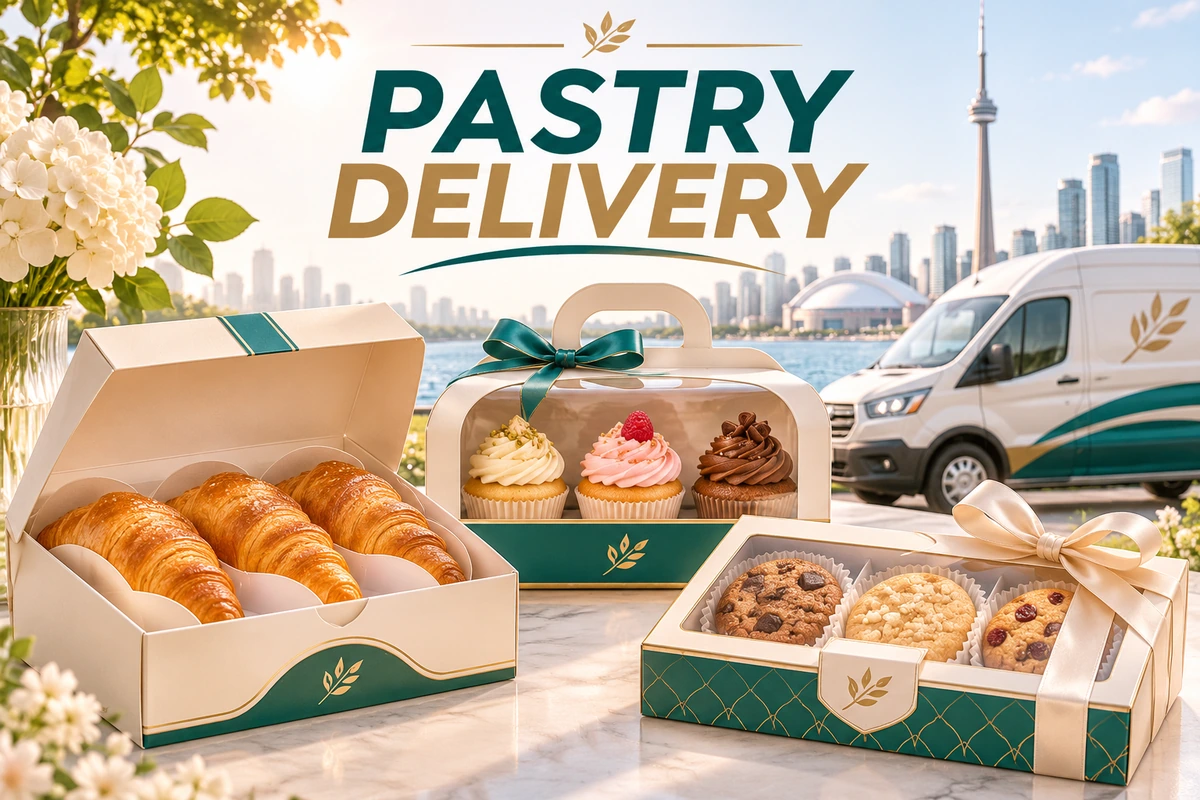
Bakery delivery packaging GTA starts with a product check: cool baked goods completely, separate crisp from moist items, immobilize delicate pieces, protect frosting and label each box for its destination. Use a rigid outer container for the courier handoff. Refrigerated perishables require a written arrangement before a Topping booking. For ordinary shelf-stable bakery orders, business courier services support planned local dispatch across Toronto and the GTA.
| Product | Primary risk | Packing choice |
|---|---|---|
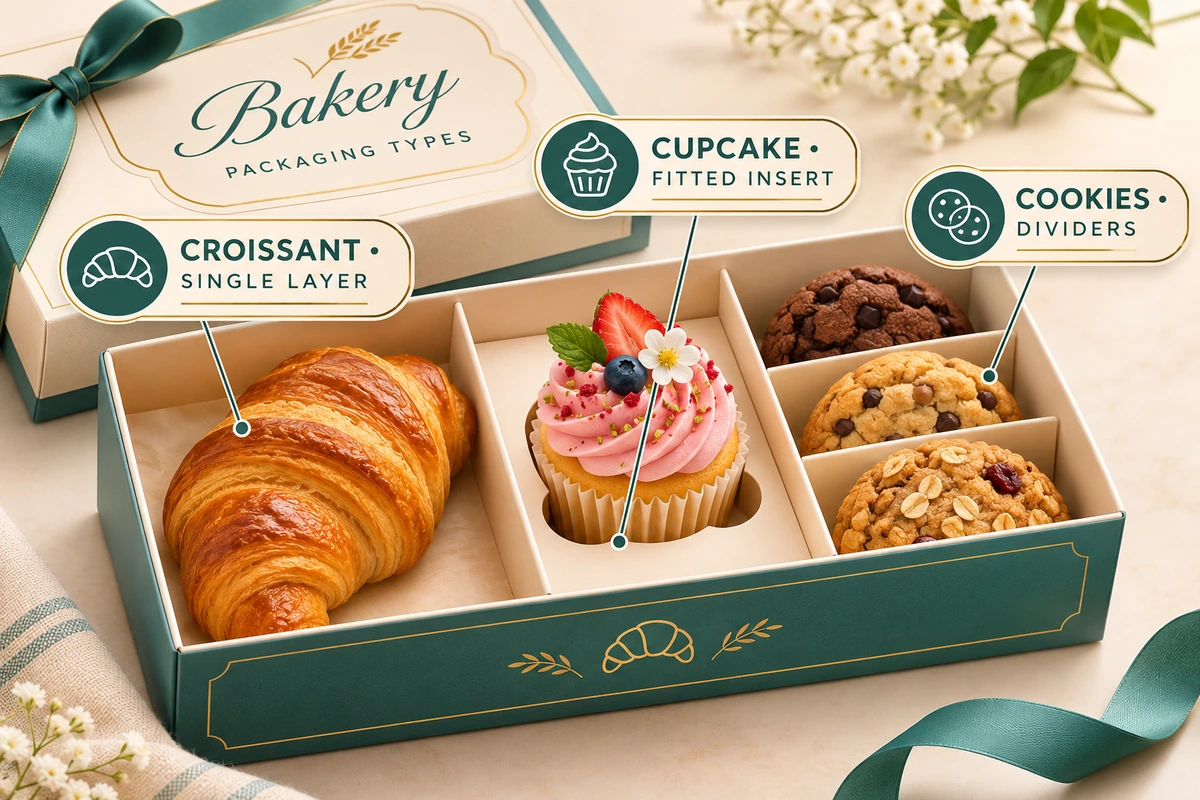
| Croissant and laminated pastry | Crushed layers and trapped steam | Cool fully; use a shallow, rigid box and avoid compression. |
| Cookies and bars | Cracks, movement and texture transfer | Separate textures with food-safe paper and fill voids. |
| Frosted cupcake | Tipping and lid contact | Use individual cavities with headroom. |
| Bread loaf | Moisture and dented crust | Cool before wrapping; use a protective, breathable package suited to the loaf. |
| Cream-filled pastry | Temperature abuse | Keep under required cold control; obtain written carrier arrangement first. |

Sort the bake before choosing the carton
Sort each product by three questions: Does it need temperature control? Can its surface touch packaging? Can it bear weight from another box? A single standard bakery carton cannot answer all three for croissants, iced cupcakes and cookies. Keep each order’s products grouped by fragility and storage condition before the packing team reaches for the first available box.
Separate crisp and moist items. A warm, sealed croissant loses its crisp exterior as moisture collects. A moist bar packed against a delicate cookie changes the cookie’s texture and can cause breakage when customers pull the pieces apart. Let baked goods cool according to the bakery’s product standard, then choose food-contact materials appropriate to their finish. Do not use a delivery deadline to justify boxing a product that is still steaming.
Place refrigerated products in a separate decision lane. Topping’s prohibited and restricted items policy bars perishable food requiring refrigeration unless agreed in writing. Ontario’s Food Premises Regulation specifies 4°C or below for potentially hazardous food held cold during transport. A closed pastry box and a cool vehicle are not temperature verification.
Read more: Packaging for local deliveries: a simple checklist
Match each pastry to a container that stops its failure mode
Use a shallow rigid box for a single layer of delicate laminated pastry. Give each piece enough room that its neighbours do not press into the flaky surface. Use a cavity insert for tall iced cupcakes, with space above the frosting. Use a divided tray or individual food-safe wrap for cookies that must stay distinct. A carry handle is convenient, but it does not compensate for a flexible base.
Pack the retail container inside a stable outer carton when the retail box cannot withstand normal courier handling. Fill the gap so the inner box cannot slide, but never crush the pastry by overfilling. Keep heavy and fragile boxes separate unless the lower package was designed to take the load. Test the closed package with a gentle lift and tilt. If the inner tray moves, repack it at the bakery.
For a daily pastry menu, keep a product-to-box chart beside the packing station. Include the cavity count, maximum product height, lid clearance and stacking rule for each item. This avoids the quiet drift where a new pastry with a taller glaze or garnish is placed in last month’s box. It is a practical quality-control step because the person boxing the order may not be the person who developed the recipe.
| Pack test | Pass | Fix |
|---|---|---|
| Lid closes | No pastry or icing contact | Taller box or lower insert |
| Tray lift | Base remains flat | Stiffer container |
| Gentle tilt | Pieces remain in place | Divider or fitted insert |
| Outer stack | No pressure reaches pastry | Ship unstacked or use stronger outer carton |
Read more: Choose the Best Packaging for Your Online Orders
Keep the bakery line and dispatch line separate
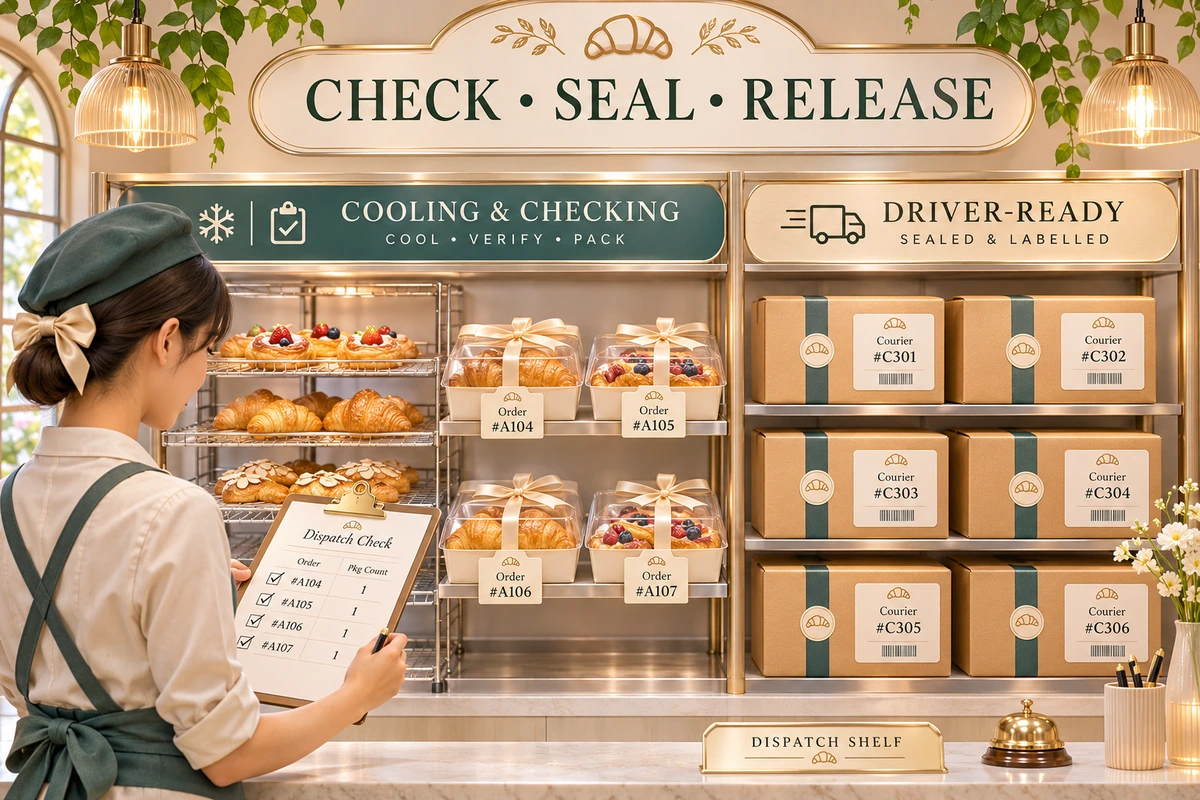
Set a packing cutoff after the bake and cooling stages, not at the moment products come out of the oven. Create an order ticket with product count, box count, recipient and delivery window. The bakery line confirms the contents; the dispatch line confirms the label, package condition and booking. A finished pastry on a tray is not a ready-to-ship order.
Use a simple two-zone shelf. Put checked retail packs in the first zone and fully sealed, labelled courier cartons in the second. Never move a carton into the driver-ready zone until its order ticket and box count match. When a customer adds an item at the last minute, return the entire order to the packing zone for recounting. Do not slip a loose cookie bag beside a sealed carton and assume the driver will recognize it as part of the order.
At pickup, compare the driver’s package count to the dispatch ticket. If one address has two cartons, enter two packages for that stop; if multiple addresses share one pickup, keep each destination’s label distinct. Topping’s FAQ describes how package counts are recorded at pickup and delivery. A clear count catches missing cartons before the route begins.
Read more: One pickup, many drops: how multi-drop delivery cuts your costs
Choose timing from freshness and the receiver’s availability
Plan the pickup only after cooling, boxing and label checks. For a predictable next-business-day order, choose next-day courier when the product’s own shelf-life and storage instructions support that timeline. For a same-day order, use same-day courier within the published cutoff. Select scheduled courier delivery when a shop, café or office has a narrow receiving window.
Give the recipient a complete address and a direct phone number. An apartment buzzer, office floor, rear loading door or café opening time can matter more than the drive between neighbourhoods. Tell the receiver how many cartons to expect and what to do when the product arrives. Food that needs special storage must go directly into that storage under its agreed transport process.
Use a decision example: a bakery has shelf-stable cookie tins for three offices and tall iced cupcakes for a nearby event. The tins can share a planned multi-drop route if all receivers are available. The cupcakes need a fitted insert and a confirmed event handoff. If their deadline conflicts with the office stops, separate the cupcake trip. Do not chase route efficiency by putting the most delicate product last.
Read more: Same-day vs next-day courier in Toronto: which one fits your delivery?
Reconcile delivery proof to the right pastry order
Give each order an internal ID printed on its outer package and dispatch ticket. Keep allergens and ingredient information in the shop’s established food-label workflow; do not rely on a courier label to replace product labelling. If an order contains several boxes, mark each box’s position in the count, such as box one of two. Check the count both when releasing the driver and when reviewing the completed stop.
Topping’s proof-of-delivery guide explains the photo and time record. Match that record to the destination order ID. Keep a pre-dispatch photo of the sealed carton when handling a delicate order. Delivery proof confirms the stop; the packing record confirms what left your bakery.
When a recipient reports a crushed box, ask for photos of both the carton and product before anyone repacks or discards them. Compare the pre-dispatch image, the handoff count and the final delivery record. Fix the stage that failed, whether it was a weak base, a missing insert, another carton stacked above it or an incorrect handoff location. Do not use a generic “driver error” label when the package itself had no structural protection.
Read more: Proof of delivery: what you get with every Topping delivery
Run one daily pastry order from cooling rack to receipt
Use this illustrative workflow for a bakery dispatch, not as a claim about a completed Topping order. The morning order contains a box of croissants, a box of iced cupcakes and a tin of cookies for one office. The baker cools the croissants fully, puts them in a shallow single-layer box and checks that its lid never presses the top. The decorator sets cupcakes in fitted cavities with lid clearance. The packer separates the cookies by type inside a rigid tin.
The dispatch worker confirms that all products meet their storage requirements, labels three outer packages with one order ID and package counts, and checks the office’s suite, receiving desk and phone. They record three packages for the single destination, then inspect each carton before pickup. The driver takes the count and keeps the fragile boxes level and free of heavy cargo above them.
After arrival, the receiver confirms three packages and stores the products as directed. The bakery matches delivery proof to the order ID and closes the ticket. If the customer says one box was missing, the pickup count, stop count and packing record identify which stage needs checking. This is why one complete ticket matters more than an informal message saying “three boxes went out.”
Read more: Office Coffee and Snack Delivery: A Smarter Solution for Busy Businesses
Test a new box before the busy dispatch period
Run a packaging trial when the product or container changes. Pack one finished item exactly as it will be sold, close the lid, move it through the same hand-carry and loading steps used on a normal day, then open it and inspect the surface. Check for frosting prints, loose crumbs, compressed corners and moisture inside the lid. Adjust the insert or carton before the new design enters the daily packing chart.
Test the actual combination that leaves the shop. A retail box may pass on its own but fail when a heavier order is stacked beside it in the courier-ready area. A large empty outer carton can also let a good retail box slide. The trial should include the outer carton, filler and the intended orientation during carrying.
Write down the failure and fix in the station chart. This gives the next shift a repeatable rule rather than a memory of one worker's experience. When the pastry size or garnish changes again, repeat the trial; do not assume last month's box still provides lid clearance.
Frequently asked questions
Can croissants and brownies share a box?
No. Separate crisp laminated pastry from a moist bar so its texture and structure survive the route.
Can cream-filled pastries go in a standard Topping courier run?
No, when they require refrigeration. Arrange written approval and compliant cold transport before booking.
Is a handle-top bakery box enough for courier delivery?
No. Test base rigidity, lid clearance and movement; use an outer carton when the retail box cannot withstand normal handling.
How should several boxes to one customer be recorded?
Use one destination with the accurate package count, and mark each carton against the internal order ID.
Should we photograph the food or the carton?
Both for delicate orders: record the finished product and the sealed outbound carton, then match them with the delivery proof.
Book the daily bakery run
Finish the cooling, packaging and count checks, then book a delivery for eligible shelf-stable orders. For recurring collections, explore business courier services. Arrange restricted refrigerated perishables in writing before promising their transport.