
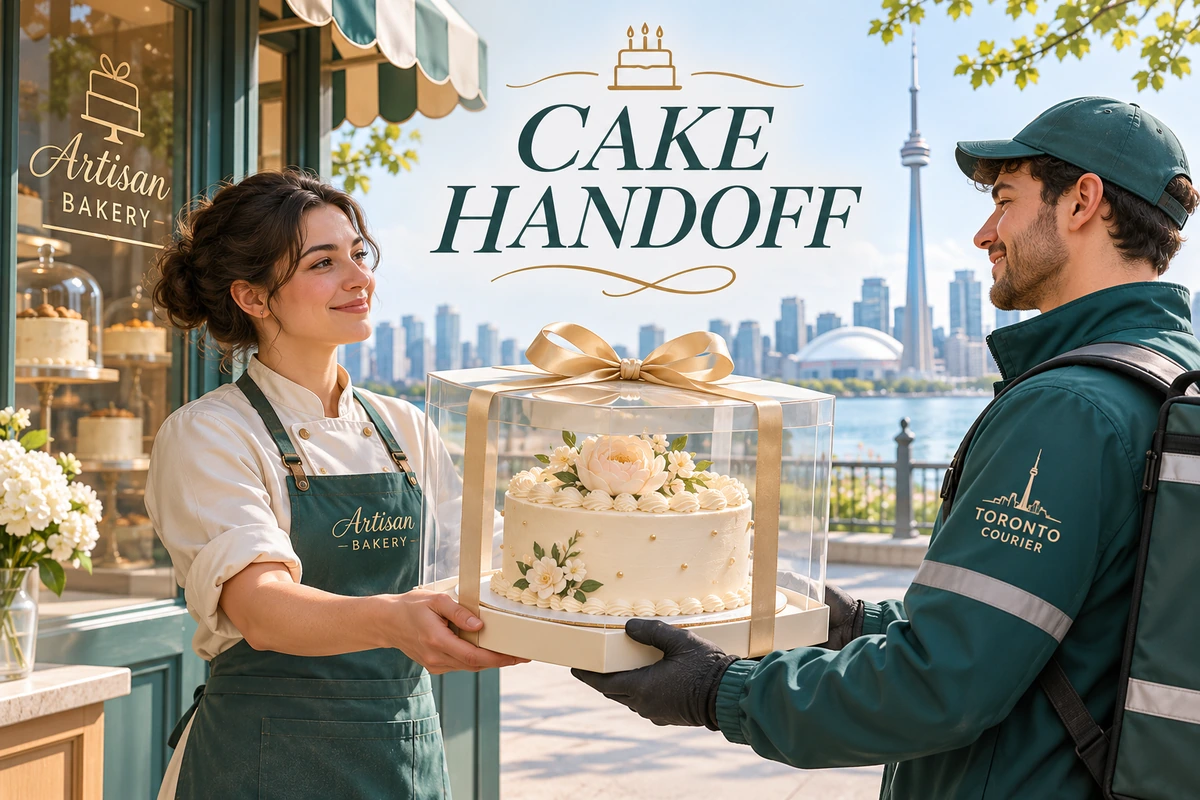
To answer how to transport a cake in Toronto, secure the finished cake to a rigid board, place it inside a box with clearance above every decoration, keep the box level and prevent it from sliding. Confirm whether the filling requires refrigeration before selecting a courier: Topping Courier does not carry perishable food that needs refrigeration without a written agreement. For an eligible, properly packed cake, review the courier services and book with the recipient’s access instructions.
| Cake or handoff | Decision |
|---|---|
| Shelf-stable, compact, protected cake | Use a rigid board, snug box and level non-slip cargo surface. |
| Cream, custard or other refrigerated perishable | Arrange documented refrigerated transport; do not use an ordinary Topping booking without written agreement. |
| Tall tiered or sculpted cake | Decide at the bakery whether it travels assembled or in separately boxed sections. |
| Office or event destination | Name a receiver, loading entrance, floor and handoff window before dispatch. |
| Decoration shifts in transit | Keep the box level; photograph the condition and contact the baker before touching the finish. |
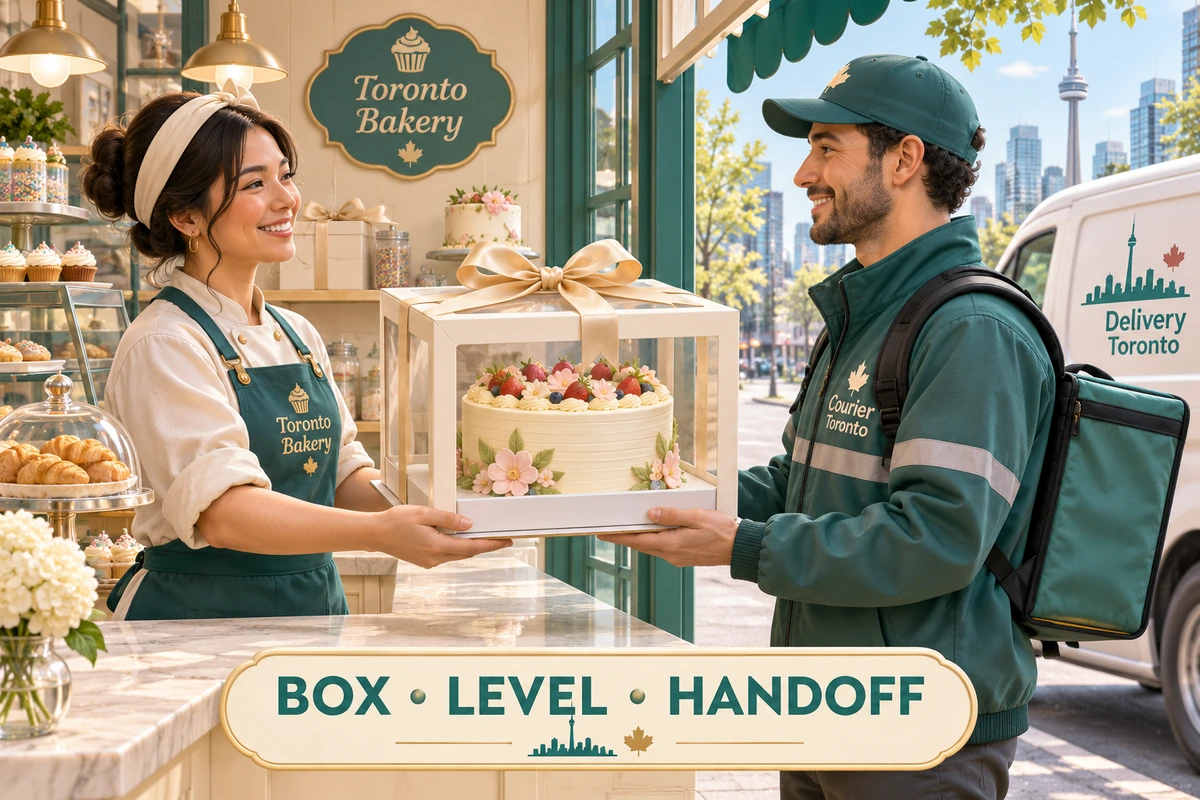
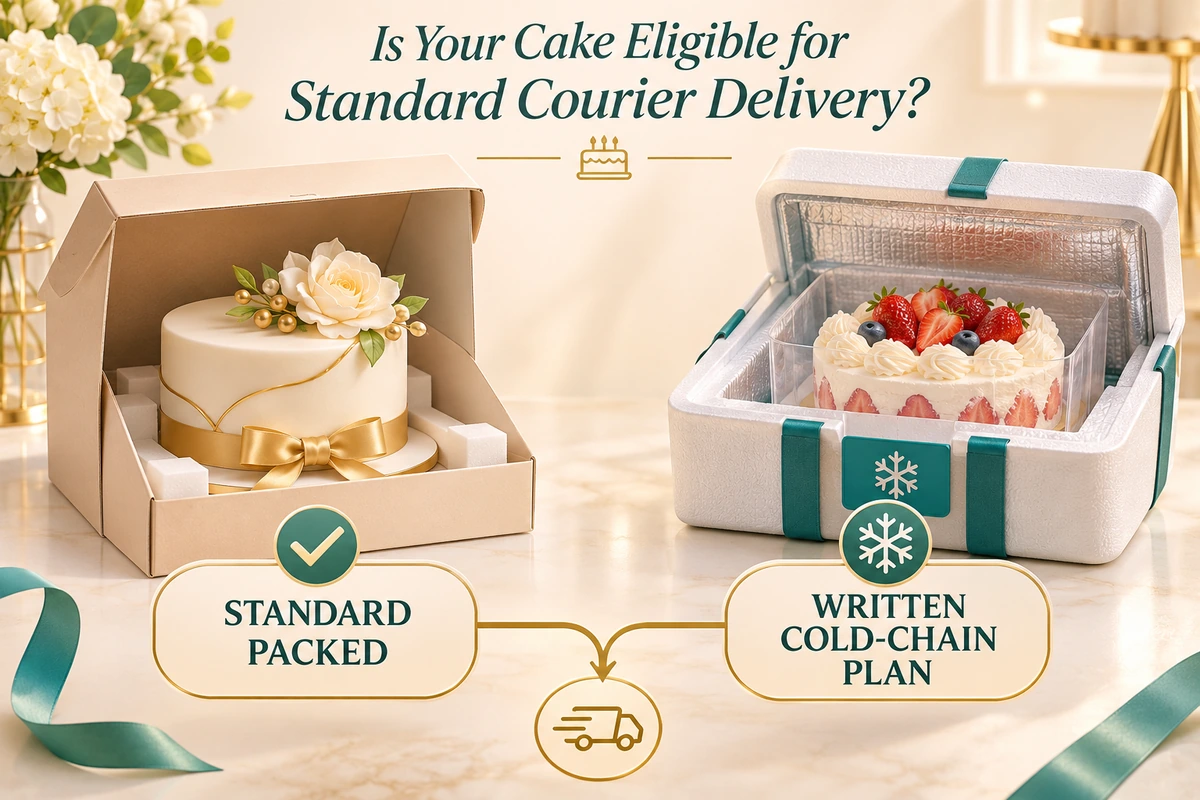
Decide whether the cake is eligible for this courier trip
Identify the filling, frosting and storage instructions first. A decorated cake is not one uniform product: a stable fondant-covered display cake and a cake with dairy cream have different transport requirements. The bakery, as the food operator, must specify the holding condition. Do not decide that an air-conditioned car counts as cold-chain transport.
Read Topping’s prohibited and restricted items rule before promising the delivery. Perishable food requiring refrigeration is prohibited unless agreed in writing; fragile products that cannot be packed for normal handling require approval before booking. Ontario’s Food Premises Regulation requires potentially hazardous food in transport to stay at an internal temperature of 4°C or below, or 60°C or above. The short preparation exception in that regulation is not a general delivery allowance. Follow the actual food classification and control method for your product.
A practical release gate is to give every cake order one of three statuses: standard packed trip, approved special arrangement, or bakery-managed transport. Do not print the courier label until the status is decided. This prevents a salesperson’s delivery promise from pushing a chilled or structurally delicate cake into a service that was never designed to carry it.
Read more: Packaging for local deliveries: a simple checklist
Stabilize the cake before closing the box
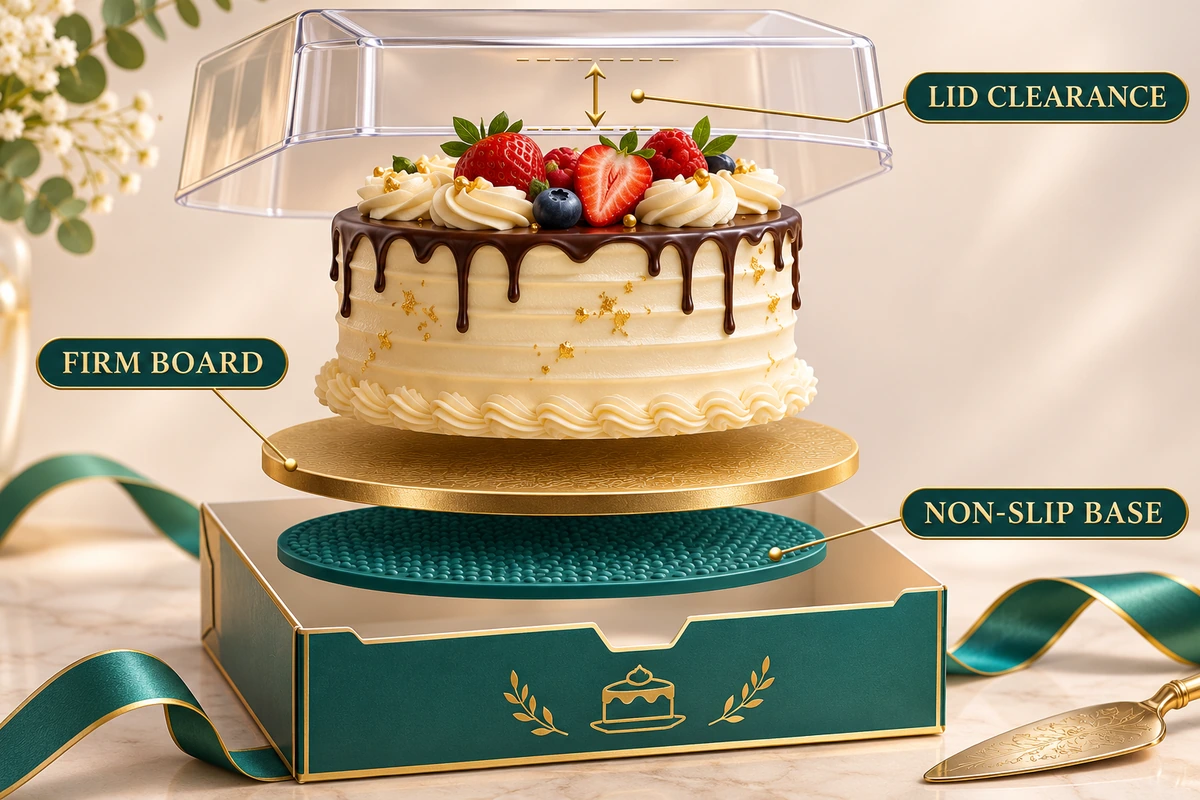
Use a board firm enough to lift the cake without bending. Fix the cake to the board using the bakery’s established method and set the board within a base that does not slide. Give frosting, sugar flowers and toppers clearance from the sides and lid. A lid that bows onto a tall decoration can damage the finish before the vehicle starts moving.
Pack detached decorations separately when the cake design calls for assembly at the venue. A tiered cake should travel assembled only when its internal structure and the route were planned for that configuration. Label the tiers and send an assembly note to the person responsible at the destination. Do not leave assembly to an untrained receiver who expected one finished box.
Use the box fit test at the packing bench: place the cake inside, close the lid, lift the package by its supported base and gently test whether the board shifts. If the board moves, secure the base; if the top touches the decoration, change the box. This is more useful than writing “fragile” on a carton that has empty space around a moving cake.
| Test | Pass condition | Correction |
|---|---|---|
| Board support | Base stays flat when lifted | Replace flexible board |
| Side clearance | Decorations do not touch walls | Use wider box |
| Lid clearance | No contact at the highest point | Increase box height |
| Movement | Board remains fixed under gentle tilt | Add non-slip support and snug base |
Read more: Choose the Best Packaging for Your Online Orders
Give the driver a level loading plan
Set the box on a flat, stable cargo floor or other level surface in a vehicle that accommodates its height. Do not put a tall cake on a sloping seat or a passenger’s lap. Put a clean non-slip mat under the box; keep other parcels from leaning into it. Measure the closed box against the vehicle opening, not just the floor area. A cake that fits only after tilting should go in a different vehicle.
Do not treat an ordinary parcel route as a specialist cake service. Choose a route with a suitable vehicle and handling arrangement before booking, and tell dispatch that the box must remain upright. For a large event cake, assign a vehicle and qualified setup team as required by the bakery. The courier handles the declared shipment and agreed service; the bakery remains responsible for the cake’s food safety and structural design.
For Toronto roads, plan the release time around the real receiving window. Traffic is not the only variable. A loading dock queue, elevator booking and walk from parking to the reception desk can take longer than the last street segment. Give the recipient an accessible phone number and instruct them to clear the handoff path before the driver arrives.
Read more: Same-day vs next-day courier in Toronto: which one fits your delivery?
Make the bakery-to-courier handoff specific
Write the order ID, recipient, full address, unit and contact on the outer box or in the booking record. State “keep upright” where relevant and identify the correct pickup entrance. Take a condition photo before sealing and a package photo at release. Photographing the attractive cake alone will not show whether its box was sound when it left the bakery.
At pickup, the release person should inspect three things with the driver: the sealed box and package count, whether the package fits the assigned vehicle upright, and the recipient handoff instructions. If one fails, pause the dispatch. A driver cannot correct a cake board sliding inside a closed box. Repack the order at the bakery instead of assuming careful driving will save it.
Use a two-person sign-off for exceptionally intricate decoration: the baker confirms the finish, and the dispatcher confirms box integrity and booking details. The useful detail here is the division of responsibility. The person who decorated the cake knows whether a flower is removable; the dispatcher knows whether a wrong unit number will strand the driver. A single generic “ready” checkbox loses both judgments.
Read more: Proof of delivery: what you get with every Topping delivery
Choose the receiver and the arrival window before pickup
Give the courier a named recipient who will answer the phone and accept the box immediately. For an event, record the delivery entrance, loading rules, elevator and room, not just the venue’s public address. For an office, verify the desk’s receiving hours. For a residence, confirm someone is home and prepared to transfer the cake to the storage condition specified by the bakery.
Select scheduled courier delivery for a known event handoff window. Use same-day courier only when the cake is finished and the published booking cutoff works. If a deadline is too close for the booked service, change the plan before release. Never substitute a tight delivery promise for safe transport.
Make an exception decision explicitly: a compact, shelf-stable boxed cake destined for a staffed office with a flexible receiving window can use an eligible standard run. A chilled cream cake headed to the same office needs a written arrangement and temperature-controlled method. The shared address does not make the two shipments equivalent.
Read more: Last-Minute Holiday Courier Toronto
Walk through one order from finishing bench to venue
Use this as a model workflow, not a claimed completed Topping delivery. A bakery receives an order for a decorated, shelf-stable single-tier cake going to a Toronto office. During production, the decorator confirms the cake’s ingredients and storage conditions. The baker fixes it to a rigid board, leaves clearance around the piping and selects a box that closes without touching the top. A dispatch worker performs the gentle movement test and photographs the cake and sealed carton.
The worker enters the office’s suite, receiving desk, contact number and accepted window into the booking. They confirm the courier’s vehicle accommodates the closed box upright. At pickup, they match order ID and package count, then hand over the box by its base. The office contact receives the tracking update, meets the driver at the specified entrance and takes the cake to a level surface.
After delivery, the bakery checks the tracking and proof of delivery against the original order. If the receiver reports damage, keep the cake level, capture the condition before intervention and determine whether the issue began in decoration, packing, loading or handoff. The two photos and delivery record help identify the stage without guessing.
Read more: One pickup, many drops: how multi-drop delivery cuts your costs
Decide what to do when the box fails the release test
Stop the pickup when the closed cake box rocks on the bench, its lid touches a topper or its board slides. Move the order back to the bakery's packing area and correct the specific failure. For a loose board, secure the cake and base. For a low lid, change the box rather than pressing the decoration down. For a tall box that cannot fit upright through the vehicle opening, assign a suitable vehicle or a different transport arrangement.
Record the revised release time in the delivery booking. Tell the receiver that the original window needs an update before the driver starts the route. A small delay at the bakery is more controllable than a damaged cake at a locked office or an event with no spare product.
If a decoration is designed to be attached on site, place it in its own labelled container and identify who will assemble it. The courier should not be asked to repair icing or position delicate sugar work. The baker's assembly instructions must accompany the order and reach the trained person at the destination.
Frequently asked questions
Can Topping Courier take a cake with whipped cream?
Not through an ordinary booking when that cake requires refrigeration. Obtain a written agreement and a compliant temperature-control plan before arranging transport.
Should the courier put the cake on the back seat?
No. Use a stable, level surface with a non-slip base and sufficient clearance; do not tilt the box to fit.
Who decides whether a tiered cake travels assembled?
The bakery designing and supporting the cake. Document the decision and the destination assembly plan before release.
Is a delivery photo enough to confirm the cake’s condition?
No. Keep the bakery’s pre-dispatch condition and packaging photos alongside the courier’s delivery proof.
What if the venue has no person to receive the cake?
Do not dispatch. Confirm a named receiver and an accessible entrance before the pickup window.
Book an eligible cake delivery with a clear handoff
Complete the storage, structural, box-fit and receiver checks first. Then book a delivery for an eligible shipment or contact Topping about a written special arrangement. Keep a chilled or unprotected cake out of a standard booking.